
In the early 1960s, media clairvoyant Marshall McLuhan declared that “the medium is the message.”1 But what if the message itself is wrong? No amount of new media — text reminders, social campaigns — will encourage younger people to donate blood if they aren’t hearing a compelling message that speaks to them.
Blood donation among younger Americans is dropping, even as engagement among older adults holds steady or is rising.2,3 Post-COVID-19, we’ve seen the number of older donors increase, while the number of the youngest donors has dropped precipitously. Today, as older donors age out, they aren’t being replaced by younger donors at the rate needed. If we don’t find messages that land with Millennial (those born 1981-1996) and Gen Z (those born 1997-2012) donors, we could face more frequent blood shortages in the future.
Blood Centers of America (BCA), a cooperative consisting of more than 60 independent community blood centers, established the Geodatabase Optimization for the Location of Donors (GOLD) in 2018. GOLD is the industry's largest centralized data repository of donor demographics and donation frequency from U.S.-based blood centers.4 The repository comprises more than 25 million donor records and 126 million donations records dating back to 2010.
We compared pre-pandemic (2017–2019) and post-pandemic (2022–2024) data across age brackets from donors aged 16–24 through donors aged 73 and older. Across nearly every age group, donor numbers increased after the pandemic. The only exceptions are those younger than age 35 — primarily those from Gen Z, with younger Millennials just behind them. Donors aged 16–24 dropped from roughly 2.7 million to 1.7 million, while those aged 25–34 fell from 1.3 million to just below 1 million. Every older cohort, from older Millennials through Boomers, rose.
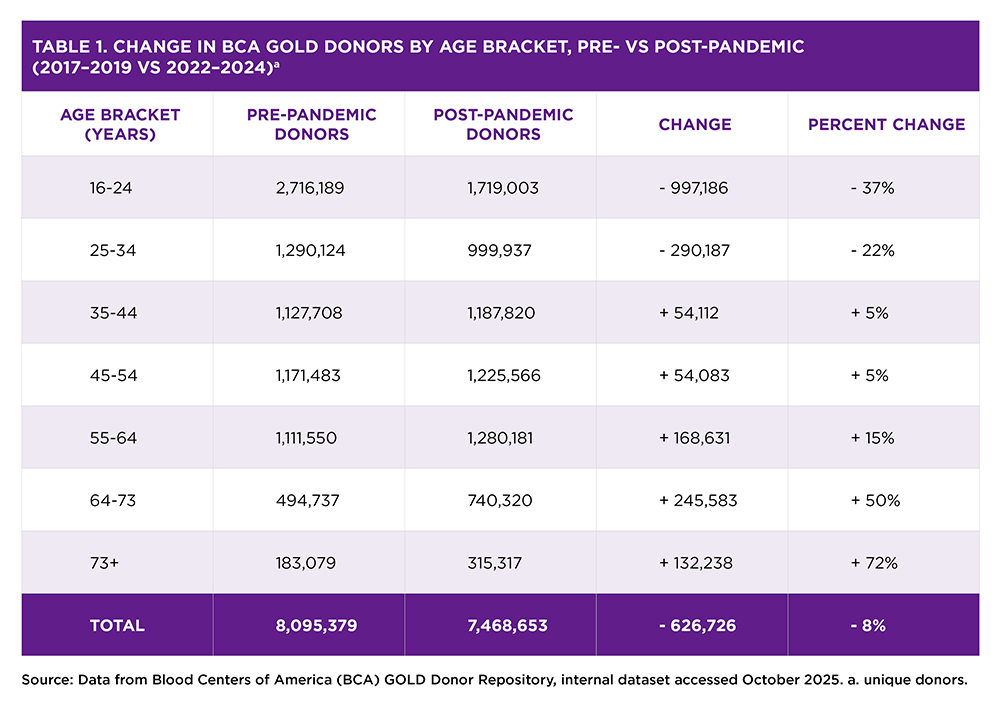
This isn’t purely a pandemic effect. It’s a generational fracture. It may not even be as simple as failing to connect with young donors. A flat line would suggest failure. A 37% drop of roughly one million donors aged 16–24 suggests a lack of meaningful connection with this cohort. In any organization, losing a third of a critical component would demand a new strategy.
Understanding why each generation responds differently to blood donation messaging may be key to rebuilding the pipeline. Roughly 70 million Baby Boomers (those born 1946–1964) and 65 million Gen Xers (those born 1965–1980) still provide more than half of all U.S. blood donations.5 Boomers, raised by the Greatest Generation (those born 1901-1927), are more likely to equate service with citizenship; appeals such as “Do your part” still land because they mirror that social-contract mindset. Gen X inherited that duty minus the optimism. Shaped by recessions, divorce, and 24-hour news, they are more likely to trust action over slogans. Tell them the shelves are low, and they are more likely to donate (albeit perhaps with a cynical joke, true to form).
Duty motivates Boomers; pragmatism moves Gen X. Both still respond to the traditional appeals that built the modern donor system — that big red blood drop. But the very language that works for them no longer seems to reach younger audiences. In fact, it may even be pushing them away.
For Millennial and Gen Z Americans, that same red drop reads differently. To them, it’s branding — corporate, not communal.6 They are less likely to donate blood because a sign tells them to; they are more likely to give if they trust the system and see the impact. They crave transparency; they may be more likely to respond with messaging that explains how donation works, who it helps, and why it matters. A donation receipt connects donors with patients, but it doesn’t get them in the door. They want to know before they ever walk in the door who they’re helping — and why.
Recent interventions show that we’re starting to think in the right direction, but we may be getting the platform wrong – not just the message. Much of the research exploring ‘peer’ motivation in blood donation has confined itself to platforms that younger donors have largely abandoned. U.S. and Israeli studies that have looked at social-network recruitment relied on Facebook, a platform now dominated by older users.7
A 2018 U.S. pilot tested a social-networking intervention for first-time donors aged 18–24 using a closed Facebook group to foster connection. The effort increased participants’ sense of belonging but didn’t measure repeat donation and, more importantly, it unfolded on a platform that young donors were already leaving behind. Similarly, an Israeli study of 907 blood donors found that Instagram use was significantly higher among the youngest group (18–30 years), while Facebook preference increased with age.8 The findings underscore that platform choice still mirrors generational lines, even when the underlying motivation of solidarity remains universal. More work is needed on engagement using platforms like TikTok, where younger audiences spend more time.
To paraphrase Carl Spackler, the eccentric assistant greenskeeper in Caddyshack (1980): to catch younger donors, you have to think like younger donors. Fortunately, there’s plenty of data showing how these generations think and communicate, in particular, how they view philanthropy.
To catch younger donors, you have to think like younger donors.”
Peer-to-Peer Outreach
Peer-to-peer giving works because it taps into social contagion — the psychology of participation through belonging. Campaigns like the amyotrophic lateral sclerosis (ALS) Ice Bucket Challenge in 2014 demonstrated how simple tagging or friend-nomination mechanics can create exponential reach: people gave because someone they knew asked publicly.9 GoFundMe’s 2024 analysis found that Gen Z and Millennials are 2.7 times more likely to host a personal fundraising page and three times more likely to advocate for a cause than older generations; 80% of donations made through peer-to-peer campaigns come from first-time givers.10 Together, these findings show that younger donors don’t need another reminder to “do their part.” They prefer an authentic invitation from within their own networks.
Transparency
Transparency is the entry fee for Gen Z and Millennial trust. Younger donors expect to see exactly where their contribution goes and what it accomplishes.11 “Please Give” often isn’t enough. The Blackbaud Institute’s 2024 Next Generation of Giving report found that nearly 70% of Gen Z donors say they’re more likely to give when they know who and how they’re helping.12 Likewise, Bank of America’s analysis of next-gen philanthropy notes that Millennials and Gen Z “expect full transparency into how their investment is moving the needle.”13 These expectations echo broader trends in consumer behavior: for younger audiences, opacity feels corporate, while clarity feels communal. If we want them to give, we have to concretely show them what their hour, their pint, or their platelet truly does.
Storytelling
Numbers alone don’t move this generation. Saying that 11 million pints of red cells helped 9 million patients feels abstract; younger donors need a face, not a figure. Storytelling turns data into empathy, and the evidence backs it up. According to the Council of Nonprofits, stories are remembered up to 22 times more than facts alone; DonorPerfect reports that nonprofits using effective storytelling see 67% higher donor-retention rates and raise twice as much as those that don’t.14 For Millennials and Gen Z, a single authentic story of a trauma survivor whose life was saved by a blood transfusion or a patient with cancer who relied on blood transfusions during treatment carries more weight than any spreadsheet of units transfused. If younger donors can’t see the person behind the need, the request feels transactional, not transformational.
A simple, shareable visual could do what paragraphs of explanation can’t. Imagine a clean, 10-second animation tracing one red drop from vein to vein — from donor arm to patient wristband — showing exactly how that hour of donation time translates into survival. Vein to vein captures everything younger donors value: transparency, impact and connection.
Paired with real patient stories or playful social cues — “I gave blood and #IDidntPassOut,” or TikTok Instagram Reels challenges similar to the ALS Ice Bucket Challenge [“Tag 3 friends to donate next] approaches like these turn a private act into a public gesture of belonging. For two generations who have been shared socially since before they were born, that kind of visible participation isn’t performative; it’s how they make meaning. If we want to reach them, we’ll have to start thinking outside of the blood drop.

Jennifer Kapral, MBA, is the senior vice president of enterprise data strategy and management at Blood Centers of America. Sandra Phan is the manager of data analytics and sourcing at Blood Centers of America.
Jennifer Kapral, MBA and Sandra Phan of Blood Centers of America, Contributing Writers
July 2026
 View Issue
PREVIOUS STORY
Expanding Impact Through InnovationBACK TO ISSUE
July 2026
Transfusion is AABB’s scholarly, peer-reviewed monthly journal, publishing the latest on technological advances, clinical research and controversial issues related to transfusion medicine, blood banking, biotherapies and tissue transplantation. Access of Transfusion is free to all AABB members.
Learn More About Transfusion Journal
Keep abreast of what's happening in the field of biotherapies with CellSource - AABB's monthly update on the latest biotherapies news.

To submit news about the blood and biotherapies field to AABB, please email news@aabb.org.


President
Jose Cancelas, MD, PhD, CABP
Chief Executive Officer
Debra Ben Avram, FASAE, CAE
Chief Communications and Engagement Officer
Julia Zimmerman
Director of Marketing and Communications
Jay Lewis, MPH
Managing Editor
Kendra Y. Mims, MFA
Senior Communications Manager
Drew Case
AABB News
(ISSN 1523939X) is published monthly, except for the combined November/December issue for the members of AABB; 4550 Montgomery Avenue; Suite 700 North Tower; Bethesda, MD 20814.
AABB is an international, not-for-profit association representing individuals and institutions involved in transfusion medicine, cellular therapies and patient blood management. The association is committed to improving health by developing and delivering standards, accreditation and educational programs that focus on optimizing patient and donor care and safety.
+1.301.907.6977
Email: news@aabb.org
Website: www.aabb.org
Copyright 2025 by AABB.
Views and opinions expressed in AABB News are not necessarily endorsed by AABB unless expressly stated.
Notice to Copiers: Reproduction in whole or part is strictly prohibited unless written permission has been granted by the publisher. AABB members need not obtain prior permission if proper credit is given.


4550 Montgomery Avenue
Suite 700, North Tower
Bethesda, MD 20814
301.907.6977