As the field of biotherapies continues to evolve, more professionals are pursuing the Certified Advanced Biotherapies Professional (CABP) credential to demonstrate expertise, strengthen interdisciplinary collaboration and advance their careers.
During a chat at the 2025 AABB Annual Meeting, Jeff Wren, MBA, CABP, AABB’s vice president of biotherapies; Christie Malone, MT(ASCP)SBB, CABP, vice president of biotherapies custom solutions at Vitalant; and Kevin Land, MD, executive medical director of biotherapies and vice president of clinical services at Vitalant, discussed the importance of the CABP credential for the field, preparing for the CABP exam, available study resources and how CABP certification can build professional confidence.
AABB now offers multiple resources to help prepare for the CABP exam, from a study guide to a video bootcamp series, sample exam questions and more.
“For those looking to take the exam this year, we now have the CABP Study Guide, which recaps the information you can expect on the exam, as well as a set of sample questions,” Wren said.
Prospective CABPs and CABP candidates can refer to the CABP resource library on the AABB website for all available resources.
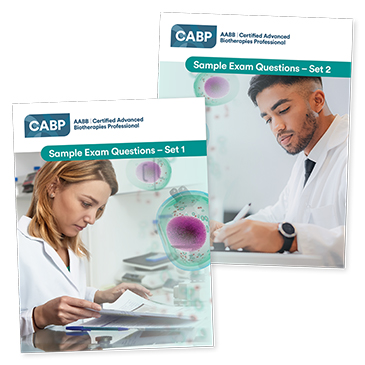 Practice exams can be one of the most effective ways to prepare for the CABP exam. Sample questions allow candidates to identify strengths and weaknesses across the exam’s seven domains and tailor their study approach accordingly.
“Before going to medical school, I took one of those MCAT prep classes, and I quickly learned that the true gold of that, besides preparing in general, was the deep question library. It was really easy to determine early on that I needed to work on my chemistry,” Land said.
Malone agreed. “Years ago, whenever I took the SBB exam, I did the exact same thing: multiple practice exams, then through a variety of study, different paradigms of study and then another practice exam. I recommend the same approach to the CABPs who are practicing now,” she said.
“We've got two sets of 100 questions each,” added Wren. “By taking the sample exam, I was able to see which domains I was strong in, such as quality and regulatory surprisingly, but where I need a little bit more work, such as patient clinical care and equipment, so using the sample exam really was the first step to let me see where I needed to do some studying.”
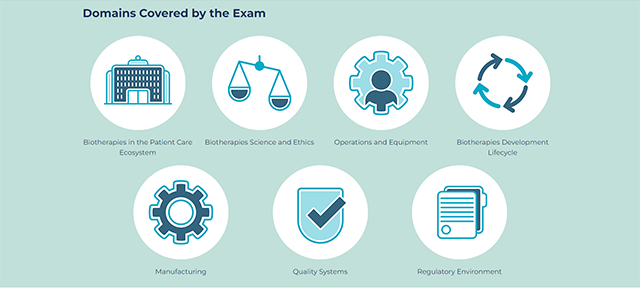
The CABP exam covers seven domains spanning multiple aspects of biotherapies. Rather than testing highly specialized details, the exam emphasizes core principles that apply across disciplines.
“The questions really try to point to first principles, often. It's more of an approach to cell and gene therapy, either from the nursing perspective, the lab perspective or quality perspective,” shared Land.
“People I've talked to are interested in becoming CABPs, but they don't know how much information they need to actually know or how deep they need to know each topic,” Wren stated. “Taking that sample exam is the first step for that.”
Malone added that the study guide is a tremendous assistant today. “Not having those tools in the early days was challenging!” she said. “I took the AABB Cellular Therapies certificate program to do a little crash course. It's a great introductory level, but the CABP was considerably deeper than the certificate level.”
The CABP credential helps professionals demonstrate expertise in a rapidly evolving field that integrates laboratory science, clinical care and regulatory oversight. For many, certification provides external validation of years of experience and specialized knowledge and helps individuals gain a wider perspective, allowing them to better operate as part of cross functional teams.
“It’s a legitimate credential. If you pass, it shows everyone. It validates that you know what you're talking about,” explained Wren.
Malone shared that the CABP has made a huge difference in her career journey. “After nearly 30 years in the industry, my experience has led me down the cell therapy pathway, where it was really nice to be able to add a credential that says, 'I'm a blood banker and a cell therapy professional,'” she said.
“There's so many domains of knowledge in health care,” Land said. “What I really like about the exam and the certification is you really need to learn a little bit of everything if you're part of a highly integrated functional team. I really applaud how the nurses know a little bit about the lab, and the lab know a little about the nurses, because I think it rounds people out.”
Christie Malone, MT(ASCP)SBB, CABP, is the vice president of biotherapies custom solutions at Vitalant, where she leads strategic development, commercial activities and operational innovation across the organization’s biotherapies portfolio. With deep expertise in cellular therapy, donor operations and complex clinical‑operational integration, Malone guides cross‑functional teams in advancing next‑generation biotherapy capabilities that support both research and patient‑focused programs.
Kevin Land, MD, is executive medical director of biotherapies and vice president of clinical services at Vitalant and an adjunct professor of pathology at UT Health San Antonio. He supports AABB/FACT-accredited cellular therapy programs and multiple clinical trials in cell and gene therapy and helped develop the Certified Advanced Biotherapies Professional (CABP) credential.
Even experienced professionals sometimes question whether they have the expertise needed to participate in high-level discussions within the field. The CABP credential can help reinforce confidence in one’s knowledge and experience.
“[Becoming a CABP} really has made a big difference in being able to put the confidence behind my ability to have some conversations with people, like the conversation I'm having right now with Dr. Land about cell therapy.”
For professionals, imposter syndrome is very common, and the world is rapidly changing. It is an indicator that your skill has outperformed your confidence in that skill. “Isn't it funny that even getting that certificate helped you increase your perception of confidence, even though you already had the skill that everyone else might see?” Land pointed out.
Wren added, “It helps you show up with confidence.”
Today, many biotherapies professionals throughout the world hold the CABP credential, and interest continues to grow as more individuals pursue certification. At conferences and professional meetings, the designation often sparks conversations about exam preparation, career paths and shared experiences within the biotherapies field.
“It’s fun when you're going out into the world, or you're attending a conference and you see that CABP title,” Wren said. “I found someone today who had CABP in her title. So, I approached her and said, ‘Hi, I'm Jeff Wren, I'm also a CABP. When did you take your exam? How did you study? Have you found that it helps differentiate you from your colleagues?’ I got to make a new friend.”
PREVIOUS STORY
AABB Foundation Grant Spotlight: Tessa Barrett, PhDBACK TO ISSUE
March 2026NEXT STORY
Advancing Trauma Care in the Field
Transfusion is AABB’s scholarly, peer-reviewed monthly journal, publishing the latest on technological advances, clinical research and controversial issues related to transfusion medicine, blood banking, biotherapies and tissue transplantation. Access of Transfusion is free to all AABB members.
Learn More About Transfusion Journal
Keep abreast of what's happening in the field of biotherapies with CellSource - AABB's monthly update on the latest biotherapies news.

To submit news about the blood and biotherapies field to AABB, please email news@aabb.org.


President
Jose Cancelas, MD, PhD, CABP
Chief Executive Officer
Debra Ben Avram, FASAE, CAE
Chief Communications and Engagement Officer
Julia Zimmerman
Director of Marketing and Communications
Jay Lewis, MPH
Managing Editor
Kendra Y. Mims, MFA
Senior Communications Manager
Drew Case
AABB News
(ISSN 1523939X) is published monthly, except for the combined November/December issue for the members of AABB; 4550 Montgomery Avenue; Suite 700 North Tower; Bethesda, MD 20814.
AABB is an international, not-for-profit association representing individuals and institutions involved in transfusion medicine, cellular therapies and patient blood management. The association is committed to improving health by developing and delivering standards, accreditation and educational programs that focus on optimizing patient and donor care and safety.
+1.301.907.6977
Email: news@aabb.org
Website: www.aabb.org
Copyright 2025 by AABB.
Views and opinions expressed in AABB News are not necessarily endorsed by AABB unless expressly stated.
Notice to Copiers: Reproduction in whole or part is strictly prohibited unless written permission has been granted by the publisher. AABB members need not obtain prior permission if proper credit is given.


4550 Montgomery Avenue
Suite 700, North Tower
Bethesda, MD 20814
301.907.6977