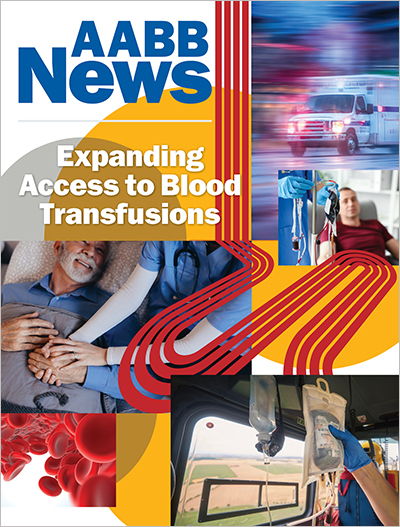

Nearly 16 million blood components are transfused each year in the United States.1 Most of these transfusions, whether red blood cells or platelets, take place in hospital settings, including emergency departments, critical care, surgery or inpatient medicine.2
However, as the field continues to evolve, an increasing number of transfusions are taking place in nontraditional settings, with the goal of getting life-saving blood to patients sooner or in locations that may minimize logistical challenges for patients. Last year, AABB acknowledged the growing interest in expanding access to both prehospital and out-of-hospital transfusions with the publication of its first edition of Standards for Emergency Prehospital and Scheduled Out-of-Hospital Transfusions (EPSOHT Standards).3
AABB News recently spoke with Fatima Aldarweesh, MD, QIA, associate professor of pathology and medical director of transfusion medicine section at the University of Chicago, about her institution’s experience with setting up an out-of-hospital transfusion program, which has increased her community’s access to safe, high-quality transfusion care given outside of hospital walls.
Unlike prehospital transfusions, which are conducted through emergency medical services, out-of-hospital transfusion is typically done in non-emergency settings, including infusion centers, dialysis centers, nursing homes, long-term care facilities and hospice or home care environments.
For the University of Chicago, setting up an out-of-hospital transfusion program began as an attempt to improve convenience for patients undergoing transfusion, Aldarweesh explained.
“The main hospital for the University of Chicago is located in Hyde Park, on the south side of Chicago,” Aldarweesh said. “A lot of the patient population lives in the suburbs, which could be anywhere from 40 to 50 miles away from the main campus.”
In the suburbs of a city like Chicago, traveling 40 to 50 miles could take more than an hour. Having to travel these distances, can be a significant quality of life issue for some patients, according to Sandhya R. Panch, MD, MPH, associate professor, division of hematology and oncology and medical director of transfusion, Fred Hutch University of Washington, which also has out-of-hospital transfusion locations.
“Whether it is a patient receiving chemotherapy who still maintains a busy, active lifestyle, or a patient at the end of life—each with different goals of care—they should not have to be transported one to three hours to receive transfusions,” Panch said.
The University of Chicago opened its first out-of-hospital transfusion site in December 2016 at the Center for Advanced Care at Orland Park. Since then, the institution has learned about some of the “best practices” needed to launch and sustain a successful program.

“One of the first steps is to identify key players at those infusion centers and make sure you have the proper infrastructure in place,” said Aldarweesh. Infrastructure could be related to staff, ordering of products, transport protocols or storage systems.
“For example, we know per AABB standards that the temperature of blood products needs to be monitored 24/7 and if there is a change in temperature immediate corrective action must be taken,” Aldarweesh said. As the out-of-hospital transfusion sites are not staffed 24/7, reliable courier services have been a key part of their success, delivering blood products back to the main campus at the end of each day.
Training of staff is another key aspect. Health care teams receive extensive training in blood product handling and administration, emergency response protocols and adverse reaction management.
“On the receiving end of these products there are mostly nurses, not lab personnel,” Aldarweesh said. “They are mostly familiar with inspection and transfusion of blood products but are not typically trained for handling blood products or packing them for transport.”
Standard operating procedures must be put in place for these procedures and other aspects of regulatory compliance, as facilities that want to perform out-of-hospital transfusions must meet the same Food and Drug Administration (FDA) and state licensing requirements as any other facilities performing transfusions.
All of these things together, protocols, staff training, technology and regulatory compliance, are essential to maintaining the safety and quality of transfusions at these sites.
Aldarweesh said that the University’s of Chicago’s out-of-hospital transfusion programs are considered a success. This is measured through a variety of quality metrics, including provider and patient satisfaction, number of transfusions and safety events.
“In terms of patient satisfaction, I have spoken with a couple of patients during my off-site visits, and they absolutely love this program,” Aldarweesh said. “These were patients that were tired of coming all the way downtown, fighting traffic, finding parking at a busy hospital—all for transfusion.”
Whether it is a patient receiving chemotherapy who still maintains a busy, active lifestyle, or a patient at the end of life—each with different goals of care—they should not have to be transported one to three hours to receive transfusions.” – Sandhya R. Panch, MD, MPH
Since inaugurating the first location in 2016, the University of Chicago created a lot of quality-related documents, workflows procedures, training protocols and more that is scalable, packaged and ready to go for future sites. In November 2022, it added a site at the Comprehensive Cancer Center at Silver Cross, and in August 2024, another at the Cancer Center at Crown Point.
“Collectively at all three sites, we transfuse about we transfuse about 400 red blood cell units and 80 platelet units per year,” Aldarweesh said.
But being successful does not mean there is no room for improvement. One area of implementation that could have gone more smoothly was the integration of technology and communication systems, particularly certain aspects of electronic health records, Aldarweesh said.
“Right now, we rely on emails from off-site to tell us when patients are coming for transfusion,” Aldarweesh said. “Although we are all using EPIC, and are all in the same health care system, those off sites have different licensure and a different electronic health record structure than the main campus.”
When the e-mail is received, the blood bank technologist replies that a unit will be prepared, and they make sure they have a type and screen for the patient before the product is packed, sent and delivered. If this had been thought through upfront, Aldarweesh said, it would definitely have streamlined the process.
Both Aldarweesh and Panch are confident in the future of out-of-hospital transfusion as a method to make transfusion more convenient and available to the patients that need them. These programs do take work to set up, but those efforts should not be a barrier to their establishment.
“In Rwanda, they are using drones to get blood products to the people who live in remote areas,” Panch pointed out.
Indeed, in Rwanda, the majority of the population live in rural areas and there are often poor road conditions. In 2016, the Government of Rwanda launched a program using unmanned aerial vehicles, or drones, to deliver commodities to different locations in the country. A study of the use of drones to deliver blood products showed a mean delivery time of 49.6 minutes, which was about 80 minutes faster than road delivery times. Drone delivery also resulted in less blood component wastage.4
“The type of program they put in place in Rwanda to improve access to care is an example of what a country like the United States could stand to enhance within its own systems to improve delivery of blood products,” Panch said.
To accomplish these enhancements, teamwork and collaboration will be key, Aldarweesh added. “It will take the work of multiple disciplines around a hospital to make out-of-hospital transfusion programs go live and be successful.”
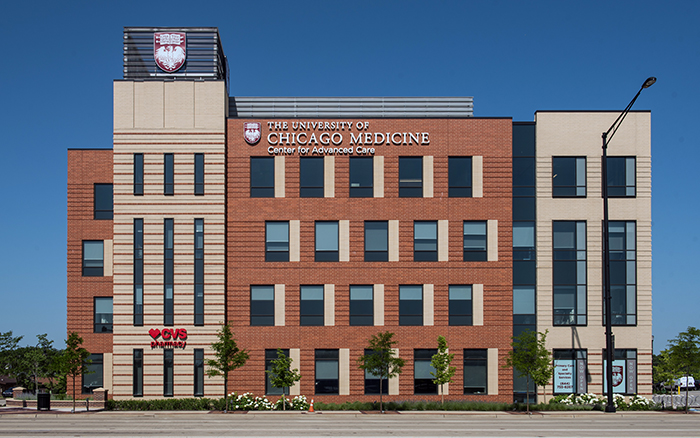
In 2016, University of Chicago Medicine identified a gap: patients receiving cancer care in the suburbs still had to travel into Chicago for blood transfusions. Its Orland Park site launched an out-of-hospital transfusion program to bring blood products closer to patients receiving care locally.
Gunta Musa, MHA, MT(ASCP)SBB, manager of transfusion medicine at University of Chicago Medicine, shares how the program was developed and how it operates today.
What clinical or operational gap led University of Chicago Medicine at Orland Park to develop an out-of-hospital transfusion program?
The main issue we wanted to address was the distance that patients had to travel to receive blood transfusions. For many patients, their other care was offered at the University of Chicago Medicine Orland Park location, and the preference was not to travel to another location in Chicago for a blood transfusion.
What need are you seeing in your patient population?
Most of the patients served are receiving care for cancer, so the location is important. For many of these patients, avoiding a long drive into the city or navigating a large facility is difficult to manage. The University of Chicago Medicine at Orland Park is a much smaller facility located in the suburbs, where patients can conveniently undergo a blood transfusion much closer to home.
From a medical oversight perspective, how is the program structured?
Transfusions are administered by licensed personnel in accordance with our University of Chicago Medicine blood administration policy. Our policy includes response to transfusion reactions with medical oversite by transfusion medicine faculty at the main campus. Patients who will not be observed by medical personnel post-transfusion (i.e. discharged home following outpatient transfusion) should be provided instructions regarding adverse reactions and appropriate follow-up.
How do you manage blood product storage, transport and cold chain requirements outside the traditional hospital environment?
We use validated blood supplier boxes for transport via a scheduled, dedicated courier, who is made aware of and abides by blood product requirements. Upon arrival at Orland Park, the blood products are stored in a validated, temperature-monitored blood product refrigerator. Temperature deviation alerts are sent out to the Orland Park lab leadership to take immediate action. The facility is closed overnight, and blood products are not allowed to remain overnight. Any blood product not transfused on the day of scheduled transfusion is repacked and returned via courier to the main campus. We use a Network Site Blood Bank Release Form that travels with the blood products to track cold chain requirements.
What metrics are you tracking to evaluate safety, effectiveness and sustainability?
We review and monitor safety events, completed Network Site Blood Bank Release Forms, the number of transfusions/blood products, and transfusion reactions in our monthly quality meetings.
What advice would you offer other institutions considering an out-of-hospital transfusion program?
First, consider the transport implications – per FDA requirements – if crossing state lines. Also, we recommend setting up an agreement with a reliable courier that is aware of, and strictly follows, transport of blood product requirements. Finally, developing a reliable communication process is essential.
BACK TO ISSUE
March 2026NEXT STORY
Transfusion on the Front Lines
Transfusion is AABB’s scholarly, peer-reviewed monthly journal, publishing the latest on technological advances, clinical research and controversial issues related to transfusion medicine, blood banking, biotherapies and tissue transplantation. Access of Transfusion is free to all AABB members.
Learn More About Transfusion Journal
Keep abreast of what's happening in the field of biotherapies with CellSource - AABB's monthly update on the latest biotherapies news.

To submit news about the blood and biotherapies field to AABB, please email news@aabb.org.


President
Jose Cancelas, MD, PhD, CABP
Chief Executive Officer
Debra Ben Avram, FASAE, CAE
Chief Communications and Engagement Officer
Julia Zimmerman
Director of Marketing and Communications
Jay Lewis, MPH
Managing Editor
Kendra Y. Mims, MFA
Senior Communications Manager
Drew Case
AABB News
(ISSN 1523939X) is published monthly, except for the combined November/December issue for the members of AABB; 4550 Montgomery Avenue; Suite 700 North Tower; Bethesda, MD 20814.
AABB is an international, not-for-profit association representing individuals and institutions involved in transfusion medicine, cellular therapies and patient blood management. The association is committed to improving health by developing and delivering standards, accreditation and educational programs that focus on optimizing patient and donor care and safety.
+1.301.907.6977
Email: news@aabb.org
Website: www.aabb.org
Copyright 2025 by AABB.
Views and opinions expressed in AABB News are not necessarily endorsed by AABB unless expressly stated.
Notice to Copiers: Reproduction in whole or part is strictly prohibited unless written permission has been granted by the publisher. AABB members need not obtain prior permission if proper credit is given.


4550 Montgomery Avenue
Suite 700, North Tower
Bethesda, MD 20814
301.907.6977