
On the day University Hospital in New Jersey launched its prehospital transfusion program, a critical motorcycle collision quickly revealed why the initiative mattered.
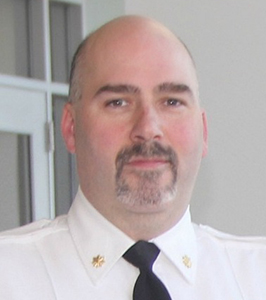
Armand Cayer, MBA, MICP, MPO, former EMS coordinator for advance life support at University Hospital, recalled that carriers transported blood products to the scene of the collision and administered a blood transfusion within nine minutes of the incident. The patient, who had a shock index greater than one and sustained significant injuries, received two units of whole blood and was transported 17 minutes after the crash to a Level 1 trauma center, where they then underwent two months of surgeries and rehabilitation.
“We received approval and launched the program simultaneously on ground and air that day, so the timing was incredible,” said Cayer. In his former role, Cayer was responsible for the clinical and operational aspects of all paramedics within the University Hospital EMS system. “When the patient arrived at the trauma center, they were placed on a massive transfusion protocol. But that outcome is directly related to the early initiation of whole blood transfusion.”
For Cayer, that moment was a culmination of three years of planning, coordination and advocacy to bring prehospital programs to the region. And in May 2025, University Hospital became the first state-certified Level 1 trauma center in New Jersey to administer life-saving blood directly in ambulances.
“We know through data and publications that people have better outcomes when they receive blood resuscitation prior to cardiovascular collapse,” Cayer said. “We want to resuscitate them before they deteriorate further.”
Cayer was honored for his visionary leadership, advocacy and commitment to transforming EMS across New Jersey during the National EMS Awards Program in November 2025.
Novneet Sahu, MD, deputy commissioner and state EMS medical director, presented Cayer with the 2025 Prehospital Administrator of the Year Award, commending Cayer for “spearheading one of the most progressive initiatives in emergency medicine, bringing blood transfusion capabilities to both air and ground operations while saving countless lives and setting a new standard for EMS care.” Sahu also noted that Cayer’s advocacy extended nationally, supporting programs across New Jersey and even assisting agencies in Oregon.
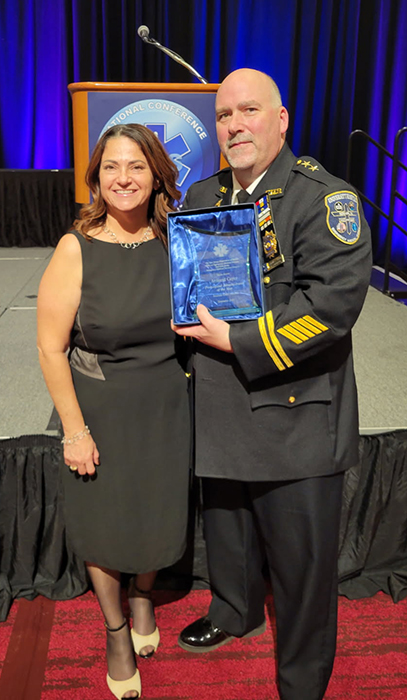
Cayer said receiving the award from Sahu was an incredible validation and a full-circle moment. “Dr. Sahu signed the waivers that allowed us to move forward. He encouraged the program because he believes in it, and I was deeply honored to receive that award from him,” he added.
Cayer told AABB News the idea for the prehospital blood program was inspired by the success of a similar initiative in New Orleans. He and his medical director consulted with Christopher Keller and Tom Dransfield of New Orleans EMS and conducted a data analysis that identified 191 community members who could benefit from prehospital blood transfusion. Based on that data, they developed an operational plan and established key partnerships.
“The strongest relationship an EMS prehospital blood program needs to have is with its blood bank manager,” Cayer said. “You cannot go out and get whole blood. You need their involvement. Bhishma Patel was the chief technologist at University Hospital, and she became my counterpart.”
Cayer credited Patel with helping him navigate the challenges of meeting The Joint Commission, AABB and CAP requirements, emphasizing the importance of adequate training and documentation.
“It’s difficult for EMS because CAP and AABB are new spaces for us,” he said. “Having that person to assist you is paramount. Bhishma taught me how to speak the language and understand critical equipment, assessments, validations, documentation and the meaning of a donor identification number. We also needed a method to record everything seamlessly in a way that integrated into the patient chart while still meeting all standards.”
Cayer cited the New Jersey Department of Health’s approval of an ambulance-based blood transfusion program in New Jersey as a defining moment in his 25-plus-year career with University Hospital EMS. Achieving that milestone, however, required overcoming significant legislative hurdles.
“New Jersey is unique, and much of the legislation and scope of paramedicine is codified. For example, the state blood bank unit defines a transfusionist as either a registered nurse or a physician,” he explained. “For EMS to enter that space, we had to be granted a waiver from state legislation stating that two paramedics could act as transfusionists in the absence of a physician or registered nurse.”
Additionally, the New Jersey Department of Health did not consider blood or blood products as an optional medication in the formulary, requiring a separate waiver to authorize their use for therapy.
“Because the aeromedical component has a flight nurse and a flight medic, they weren’t held to that same level of accountability,” Cayer said. “This was really groundbreaking on the ground side. I worked with partners at other hospitals in New Jersey who were interested in starting blood programs, and I really championed it with them. I was kind of the loudest voice in the room.”
Cayer noted that only 3% of EMS agencies nationwide can carry blood, though incremental increases are being made. “It doesn’t mean every ambulance needs to carry it. We need collaboratives and cooperatives,” he stated. “We need to share resources and create systems that don’t just create islands of blood capability but eliminate the deserts.”
He discussed the evolution of prehospital care over the past few decades, moving away from lactated Ringer's toward blood and plasma transfusions.
“Historically, EMS never had the opportunity to enter that space. We were taught to start large-bore IVs and give a lot of fluids quickly,” he said. “We didn’t realize we were diluting the blood and replacing it with a fluid that cannot carry oxygen and does not have clotting properties.”
Lessons learned from military conflicts in Vietnam, Afghanistan and Iraq demonstrated the immense value of prehospital blood on the battlefield and later informed civilian trauma care, he added.
“EMS has never really been part of that scope. It was something we couldn’t imagine,” Cayer said. “But there have been extraordinary physicians championing blood programs and producing strong data to support it, and EMS finally had the opportunity to operationalize it.”
For Cayer, there are several pillars to a successful prehospital blood transfusion program, and only one of them is transfusion. He emphasized the need for donations, advocacy, data collection and resilient equipment to ensure sustainability.
“I focused heavily on donations because eventually, we’re going to run out of blood,” he said. “In EMS, we need to be resilient. Our operation needs to be sustainable. With everything, there’s always a cost, so I wanted to make sure it was set up for success and that EMS could handle the long haul.”
The University’s Hospital prehospital program leveraged its EMS system, flight component, blood bank and trauma center to circulate blood throughout the system as a cold chain and ensure it was used.
“We know the blood is good for roughly 21 days from coming out of the arm, and everything gets tracked cradle to grave,” Cayer said. “If it’s not used in the field, we return it to the trauma center, check it into the blood bank and issue it to the trauma center. That was our process map.”
Cayer also addressed the misconception that prehospital transfusion is easy and acknowledged that blood programs are expensive and complex.
The strongest relationship an EMS prehospital blood program needs to have is with its blood bank manager. You cannot go out and get whole blood. You need their involvement.
“People believe you just put blood on the ambulance like band-aids and it’s there. They don’t understand how much activity is required to plan, circulate and manage blood components in the prehospital environment,” Cayer told AABB News. “It creates pain points when a unit needs to go out of service to return blood to the blood bank or swap units. You risk wasting blood if you don’t administer it and can’t fractionate it.”
For systems considering launching a program, Cayer recommends conducting a data-driven analysis to assess feasibility and community impact. He also mentioned operational considerations, such as maintaining the cold chain, ensuring reliable documentation and building strong relationships with stakeholders.
“I’ve process-mapped prehospital transfusion, and there are 218 steps that need to be completed before the patient ever receives one drop of blood,” he said. “That’s a deterrent if staff aren’t invested and involved. You need buy-in from your blood bank and medical director. They need to know the work is meaningful and be invested. Those are keys to success.”
Cayer stated he primarily measured the program’s success by analyzing patient outcomes, including immediate survivability and 30-day mortality rates. Efficiency and standardization were secondary. He predicted that in the next decade, ambulances may carry whole blood and plasma to improve cost-effectiveness and patient care, particularly for patients with traumatic brain injuries and burns.
“We know whole blood is the gold standard, followed by packed red blood cells and then plasma,” he said. “As a secondary blood product after whole blood, these patients will most likely receive plasma as part of a massive transfusion protocol, so it would be beneficial to get to that point as soon as possible.”
Since receiving the award, Cayer has retired from University Hospital EMS after more than 25 years of service. He currently serves as the manager of mobile intensive care unit operations at Atlantic Health, where he enjoys influencing the field in a different capacity.
Cayer said he still gets emotional when reflecting on receiving his award and the recognition from his peers.
“My nomination was submitted by some of the providers who administered that first unit of blood and supported by other blood program managers here in New Jersey. That’s a deep honor,” Cayer said. “There are 200 prehospital administrators in New Jersey. As the guy who came from Maine and worked hard to advance to paramedic, flight paramedic, field supervisor, EMS chief and EMS coordinator, being blessed with the opportunity to make such an impact in my state is truly humbling.”
PREVIOUS STORY
Transfusions and Hospice Care: A Path Forward?BACK TO ISSUE
March 2026
Transfusion is AABB’s scholarly, peer-reviewed monthly journal, publishing the latest on technological advances, clinical research and controversial issues related to transfusion medicine, blood banking, biotherapies and tissue transplantation. Access of Transfusion is free to all AABB members.
Learn More About Transfusion Journal
Keep abreast of what's happening in the field of biotherapies with CellSource - AABB's monthly update on the latest biotherapies news.

To submit news about the blood and biotherapies field to AABB, please email news@aabb.org.


President
Jose Cancelas, MD, PhD, CABP
Chief Executive Officer
Debra Ben Avram, FASAE, CAE
Chief Communications and Engagement Officer
Julia Zimmerman
Director of Marketing and Communications
Jay Lewis, MPH
Managing Editor
Kendra Y. Mims, MFA
Senior Communications Manager
Drew Case
AABB News
(ISSN 1523939X) is published monthly, except for the combined November/December issue for the members of AABB; 4550 Montgomery Avenue; Suite 700 North Tower; Bethesda, MD 20814.
AABB is an international, not-for-profit association representing individuals and institutions involved in transfusion medicine, cellular therapies and patient blood management. The association is committed to improving health by developing and delivering standards, accreditation and educational programs that focus on optimizing patient and donor care and safety.
+1.301.907.6977
Email: news@aabb.org
Website: www.aabb.org
Copyright 2025 by AABB.
Views and opinions expressed in AABB News are not necessarily endorsed by AABB unless expressly stated.
Notice to Copiers: Reproduction in whole or part is strictly prohibited unless written permission has been granted by the publisher. AABB members need not obtain prior permission if proper credit is given.


4550 Montgomery Avenue
Suite 700, North Tower
Bethesda, MD 20814
301.907.6977