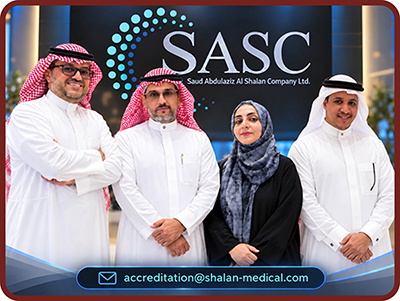
As interest in AABB accreditation grows among blood banks and transfusion services in Saudi Arabia, organizations are working to strengthen their quality systems and prepare for assessment against AABB Standards. Recently, six sites within a hospital network in the Kingdom achieved AABB accreditation following a coordinated preparation effort supported by Saud Abdulaziz Al Shalan Company (SASC).
AABB News spoke with Kaneez Zamir, quality and accreditation specialist at SASC in Riyadh, about the accreditation journey, lessons learned from the six-site project and the importance of sustaining quality improvement after accreditation.
Saud Abdulaziz Al Shalan Company (SASC) helps health care and laboratory organizations across the Kingdom prepare for accreditation and strengthen their quality systems. Our quality and accreditation department provides technical guidance and preparation behind that work.
Our most recent AABB project covered six sites within one hospital network in Saudi Arabia. Two of the sites provide both blood donor and transfusion services, while the other four provide transfusion services. Drawing on our experience with AABB accreditation projects, our quality and accreditation department and sales department worked together to support all six sites from application through project closeout.
AABB's lead assessor, Roland Fahie, conducted the assessment across all six sites. It was a great success, and all six sites are now AABB-accredited.
AABB accreditation is widely recognized as a gold standard for quality and safety in blood collection and transfusion services. Its strength lies in its specialized focus: it brings quality system requirements and technical standards together within a framework directly relevant to the care of donors and patients.
Through my work in Saudi Arabia, I have seen growing interest among laboratories, blood banks and transfusion services in pursuing AABB accreditation. This reflects a strong appreciation of the value of internationally recognized standards in guiding safe practice, strengthening quality systems and providing a consistent benchmark for improvement. Independent assessment against these standards helps facilities demonstrate their commitment to donor and patient safety.
For this project, AABB provided a common framework for six facilities with different activities and workflows. The preparation gave each site an opportunity to examine its practices while contributing to a coordinated approach across the network.
My involvement began with organizing and completing the accreditation applications and inspection self-assessment for the main facility. I coordinated the supporting information and deficiency responses, maintained regular communication with AABB and followed the process through application, assessment, closeout and certificate issuance.
Our consultants helped the facilities prepare against the AABB 35th edition Standards through online sessions, on-site visits, document reviews and mock audits. Mr. Abdulrahman Aboud, Mr. Omar Qassas and Mr. Abdulaziz AlJohani, alongside other consultants, worked directly with site teams to clarify requirements, review evidence and address gaps before the assessment.
Mr. Mostafa Hegazi maintained regular contact with each site’s director, obtaining updates and following up on information and project timelines. This combination of technical preparation and consistent coordination supported progress across all six facilities.
The principal challenge was coordinating six facilities while ensuring that preparation reflected the services performed at each site. Applications, self-assessments, requested documents, staff preparation and assessment arrangements all needed to progress together.
We addressed this through clear responsibilities and sustained communication. Mostafa liaised with site directors, and the consultancy team provided focused support both remotely and on-site.
I coordinated the assessment timetable with Roland Fahie and AABB, confirmed arrangements with each facility and organized and uploaded the documents requested before the assessment. Maintaining close communication helped us resolve questions promptly and ensured that teams understood the expectations and schedule.
One valuable improvement was a more structured approach to reviewing evidence and following up on findings. The self-assessments helped each facility identify what it needed to demonstrate, while the mock audits allowed staff to examine how their procedures and records reflected everyday practice.
The preparation encouraged teams to ask practical questions: Were responsibilities clearly defined? Could a record be followed from beginning to end? Was there evidence that a finding had been addressed?
This approach made the review process more purposeful. It also provided a foundation for continued internal auditing and improvement after accreditation.
Collaboration was essential. Within SASC, the quality and accreditation department provided technical guidance and preparation, while the sales department supported communication and project follow-up. Facility directors and staff contributed to the information, evidence and practical work needed at each stage.
My role connected these efforts with AABB’s application and assessment process. Regular communication helped us coordinate submissions, clarify requirements and keep the inspection arrangements aligned across all six sites.
The facilities also benefited from shared learning. A question raised at one site could prompt another to review its own practice. That exchange strengthened the overall preparation while respecting each facility’s scope of services.
Seeing all six facilities perform well during the assessment was deeply rewarding. That success reflected the commitment of the site teams and the sustained work invested in preparation.
For me, the most satisfying aspect was supporting the entire journey—from the initial applications and self-assessments through inspection coordination, deficiency responses and certificate issuance. Each stage depended on cooperation and careful follow-up.
For SASC, the project demonstrated the value of continuous consultancy support throughout accreditation. For the facilities, accreditation represents independent recognition that their services met the applicable AABB Standards and provides a strong foundation for continued quality improvement.
From my perspective, the priority is to sustain the practices demonstrated during assessment. Continued staff education and competency assessment, internal audits, review of quality indicators and incidents, and verification of corrective action effectiveness are central to that work.
Sharing findings and improvements across the six facilities can also help the network strengthen its services collectively. The preparation established useful channels for communication and learning that can continue beyond the accreditation project.
The lasting value of AABB accreditation lies in applying its standards consistently: using them to guide decisions, review performance and improve the reliability of care for every donor and patient.
At SASC, we are committed to supporting that improvement. We will continue working with laboratories, blood banks and transfusion services across the Kingdom to strengthen the quality and safety of their services.
PREVIOUS STORY
AABB Issues 8th edition of Standards for Molecular Testing for Red Cell, Platelet, and Neutrophil AntigensBACK TO ISSUE
October 2026NEXT STORY
Preparing for Retirement at Any Age
Transfusion is AABB’s scholarly, peer-reviewed monthly journal, publishing the latest on technological advances, clinical research and controversial issues related to transfusion medicine, blood banking, biotherapies and tissue transplantation. Access of Transfusion is free to all AABB members.
Learn More About Transfusion Journal
Keep abreast of what's happening in the field of biotherapies with CellSource - AABB's monthly update on the latest biotherapies news.

To submit news about the blood and biotherapies field to AABB, please email news@aabb.org.


President
Jose Cancelas, MD, PhD, CABP
Chief Executive Officer
Debra Ben Avram, FASAE, CAE
Chief Communications and Engagement Officer
Julia Zimmerman
Director of Marketing and Communications
Jay Lewis, MPH
Managing Editor
Kendra Y. Mims, MFA
Senior Communications Manager
Drew Case
AABB News
(ISSN 1523939X) is published monthly, except for the combined November/December issue for the members of AABB; 4550 Montgomery Avenue; Suite 700 North Tower; Bethesda, MD 20814.
AABB is an international, not-for-profit association representing individuals and institutions involved in transfusion medicine, cellular therapies and patient blood management. The association is committed to improving health by developing and delivering standards, accreditation and educational programs that focus on optimizing patient and donor care and safety.
+1.301.907.6977
Email: news@aabb.org
Website: www.aabb.org
Copyright 2025 by AABB.
Views and opinions expressed in AABB News are not necessarily endorsed by AABB unless expressly stated.
Notice to Copiers: Reproduction in whole or part is strictly prohibited unless written permission has been granted by the publisher. AABB members need not obtain prior permission if proper credit is given.


4550 Montgomery Avenue
Suite 700, North Tower
Bethesda, MD 20814
301.907.6977