Don Siegel, PhD, MD, reflects on the friendship, mentorship and scientific breakthroughs that have shaped his career and the field of blood and biotherapies.
Don Siegel, PhD, MD, professor of pathology and laboratory medicine and founding director of the division of transfusion medicine and therapeutic pathology at the University of Pennsylvania in Philadelphia, has spent decades advancing research and developing therapies that have improved the lives of patients worldwide. But for Siegel, one of the most meaningful moments of his career traces back to a longtime friendship.
In 1991, Siegel received his first AABB Foundation Early-Career Scientific Research Grant for developing phage display methods for use in transfusion medicine. Not anticipated at the time, these methods were eventually used for creating new antibodies now used in CAR T-cell therapy. He credited his late colleague Carlos F. Barbas III, PhD, a pioneer in the field of phage display, for teaching him this state-of-the-art technology. The two became close friends and co-taught an annual course on antibody engineering at Cold Spring Harbor Laboratories in New York beginning in 1996.
In 2013, Barbas was diagnosed with medullary thyroid cancer (MTC), a rare, uncurable condition. Siegel and two former Penn transfusion medicine fellows—who have since become faculty members in the division—created a CAR T-cell therapy for him in just two and a half months. Unfortunately, Barbas died before he could receive the therapy. Siegel and his colleagues completed the preclinical studies and received FDA allowance for an Investigational New Drug (IND) application, allowing them to open a clinical trial for MTC at Penn.
Looking back, Siegel described the outcome as a full-circle moment. “So far, we've treated six patients with the therapy we originally developed for our friend, who unfortunately never got to receive it himself,” he said. “It's a sad, somewhat ironic story, but a meaningful one, combining different threads of my life: the friend who taught me phage display, the cell therapy work I do at Penn, and the fellows I trained who are now faculty and worked alongside me on it. There have been some very encouraging results in our clinical trial for this otherwise incurable disease, and we're hoping for additional funding to continue the study.”
When Siegel began his clinical pathology residency at the University of Pennsylvania, he didn't know much at all about blood banking. But a rotation in transfusion medicine and blood banking drew him to the field. The combination of direct patient care and research opportunities proved to be the perfect fit.
“It's the only area in pathology where you're actually treating patients directly, such as performing apheresis procedures or consulting on transfusion needs for people who are ill,” he said. “There is a unique body of knowledge within the field of transfusion medicine, so I felt I'd be educated in a very important area that isn’t shared with other medical specialties.”
One example, he said, is the specialized knowledge required to understand blood group systems.
“Even a top hematologist trained in medicine and hematology won't necessarily know the difference between the Kell and Duffy blood group systems — knowledge that can be critical if a patient needs a transfusion and has an antibody,” Siegel said. “It's also the only area of medicine with specific training in apheresis, which is required as part of the board examination.” Most recently, Siegel and his apheresis team were very much honored to have received the national Press Ganey Pinnacle of Excellence Human Experience Award for Outpatient Practices for 2022 through 2024.
Siegel has been involved in the development of CAR T-cell therapy at Penn since 1999. Today, he directs the University of Pennsylvania’s Clinical Cell & Vaccine Production Facility within the Center for Advanced Cellular Therapies, which has manufactured more than 3,000 cellular products, including the first genetically modified cell therapy product approved by the FDA (tisagenlecleucel, Kymriah) and the first-in-human use of CRISPR-edited cells.
“I just happened to be at the right place at the right time at Penn, where the first successful cell product manufacturing and treatment of patients with CAR T-cells took place,” he said. “Dr. Carl June came to Penn and joined my division of transfusion medicine within our pathology department rather than an oncology division of a department of medicine, so we were able to work very closely together. That was all extremely exciting and oriented much of my career for the last 20-plus years.”
Siegel has since developed several CAR T-cell therapies that are currently in clinical trials at Penn and across the world through relationships with pharmaceutical companies such as Verismo Therapeutics, which he co-founded with a former Penn transfusion medicine fellow. In addition to his work at Penn, he co-founded Vetigenics, an animal health biopharmaceutical company focused on developing safe and effective antibody-based immunotherapies for companion dogs. “Eventually, we hope to change the paradigm and see ‘CARs chasing dogs’.”
“My involvement in cell engineering began with the initial CAR T-cell therapies first shown successful in 2011 in three patients with chronic lymphocytic leukemia,” he said. “That became my focus going forward — not just running the lab that makes products for patients but now developing new CAR T-cell therapies for new indications.”
Although CAR T-cell therapy was initially developed to treat blood cancers, Siegel said the technology is expanding to non-oncologic areas such as autoimmune disease, cardiovascular disease and other conditions.
For example, patients with lupus or scleroderma appear to have gone into complete remission with no disease recurrence for years after a single treatment. Disease activity scores have dropped from critical levels to zero, allowing patients to discontinue immunosuppressive medication, he pointed out.
“It's becoming clear that CAR T-cells can be designed not just to kill cancer cells, but to eliminate any cells that are ‘unwanted’,” Siegel said. “No one had initially thought one could use these CAR Ts for killing the cells responsible for autoimmune disease or fibrotic heart disease or for getting rid of the plaques that cause cardiovascular disease in your blood vessels.”
Despite its clinical success, CAR T-cell therapy remains expensive and a time-consuming process. A patient’s cells are collected via apheresis, sent to a lab to be engineered into CAR T-cells and then returned to the patient – a process that can take weeks.
“The patient needs to be treated now,” he said. “It can cost hundreds of thousands of dollars for one of these treatments. Although it still may be less expensive than a bone marrow transplant for a hematologic cancer, it’s not scalable to the millions of people with autoimmune disease. How could the health system support treatments that cost half a million dollars each?”
One potential solution to address this unmet need is the development of in vivo CAR T-cell therapy. “Many groups are working on packaging the information needed to convert a T cell into a CAR T cell by using an mRNA lipid nanoparticle — analogous to the technology used in the COVID-19 vaccine,” he said. Instead of removing a patient's cells, engineering them in a lab and reinfusing them, a patient could simply get an injection at a pharmacy, and the mRNA nanoparticles would find and convert their T cells into CAR T cells within their bodies, Siegel explained.
“It’s going to be a game changer, because it costs very little, and it's immediate,” Siegel said. “It's not far off, and there have already been positive results in various studies from groups around the world.”
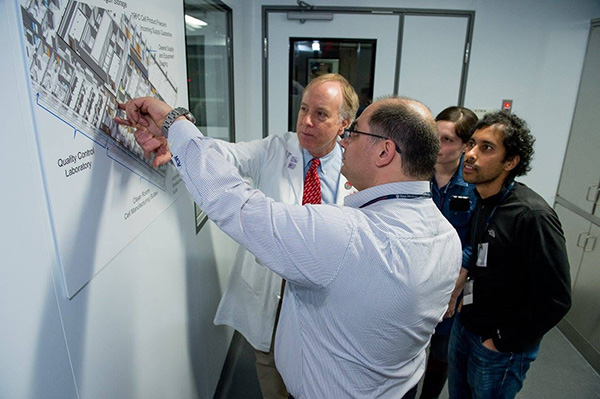
Siegel describing the cell manufacturing lab in 2017 to former transfusion medicine fellows and AABB members Michael Milone, MD, PhD; Vijay Bhoj, MD, PhD; and Suzanne Thibodeaux, MD, PhD.
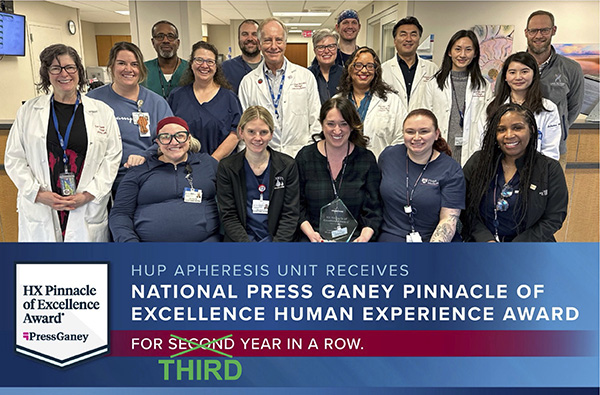
UPenn apheresis team after winning the national Press Ganey Award for the third year in a row (2024).
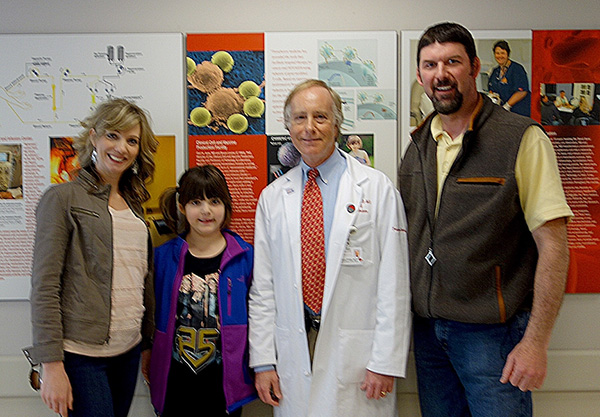
Siegel with Emily Whitehead, the first child to get CAR T-cell therapy, and her parents, Kari and Tom Whitehead in 2014 down the hall from the lab where her cells were made—two years after she became the first child in the world to receive CAR-T therapy.
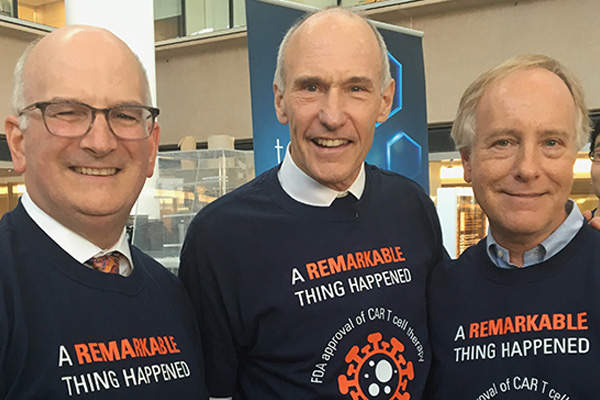
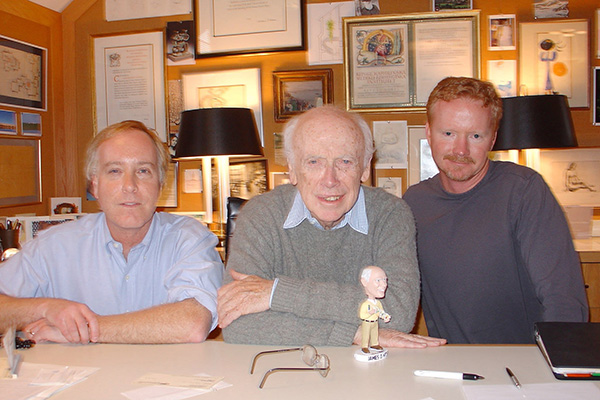
Siegel (right) with Carl June, MD (center) and Kevin Mahoney (CEO of the UPenn Health System) at a celebration at Penn the day the FDA approved the first CAR-T therapy (2017).
In recognition of his pioneering research and commitment to mentoring future leaders in the blood and biotherapies community, Siegel has been named the 2026 Emily Cooley Memorial Award recipient. He will receive the award in person at the 2026 AABB Annual Meeting in Atlanta this October.
One of the things I'm most proud of in my career here at the University of Pennsylvania has been the role I played in training residents, fellows, medical students, postdocs — people in my lab.”
“One of the things I'm most proud of in my career here at the University of Pennsylvania has been the role I played in training residents, fellows, medical students, postdocs — people in my lab,” he told AABB News. “The Emily Cooley Award, as opposed to other recognitions I've received in the past, specifically recognizes contributions to training. That's definitely one of the most important — if not the most important — aspects of my career that I've really appreciated.”
A few weeks ago, Siegel concluded a 27-year tenure as the director of the Fellowship Program in Blood Banking/Transfusion Medicine to focus more on his research and the cell therapy production lab. During that time, he mentored more than 40 trainees. Most have gone on to receive National Institutes of Health (NIH) grants. In addition, 24 of his former trainees have been awarded AABB Foundation grants of their own, three have served as presidents of the American Society for Apheresis, and nearly all have become directors of academic blood banks across the country and significant contributors to AABB.
“Looking back at people I’ve trained through the fellowship program at Penn and through an NIH T32 training grant I ran for more than 25 years, it's genuinely rewarding to teach people and see what they become,” he said. “I've attended every AABB meeting since 1989, and it's gratifying to see former trainees now serving as education coordinators, on FDA panels, and moderating or speaking in sessions at these Annual Meetings.”
While reflecting on his career, Siegel said he hopes his work will leave a lasting impact on both patients and the field.
“If any of these therapies I've been working on turn out to be highly effective, that would be lasting and important,” he said. “I also hope that the people I've helped bring into transfusion medicine — and helped nurture their careers — remember me, and that they in turn train their own successful trainees to go on to do great things.”
PREVIOUS STORY
A New Era of Blood and BiotherapiesBACK TO ISSUE
August 2026
Transfusion is AABB’s scholarly, peer-reviewed monthly journal, publishing the latest on technological advances, clinical research and controversial issues related to transfusion medicine, blood banking, biotherapies and tissue transplantation. Access of Transfusion is free to all AABB members.
Learn More About Transfusion Journal
Keep abreast of what's happening in the field of biotherapies with CellSource - AABB's monthly update on the latest biotherapies news.

To submit news about the blood and biotherapies field to AABB, please email news@aabb.org.


President
Jose Cancelas, MD, PhD, CABP
Chief Executive Officer
Debra Ben Avram, FASAE, CAE
Chief Communications and Engagement Officer
Julia Zimmerman
Director of Marketing and Communications
Jay Lewis, MPH
Managing Editor
Kendra Y. Mims, MFA
Senior Communications Manager
Drew Case
AABB News
(ISSN 1523939X) is published monthly, except for the combined November/December issue for the members of AABB; 4550 Montgomery Avenue; Suite 700 North Tower; Bethesda, MD 20814.
AABB is an international, not-for-profit association representing individuals and institutions involved in transfusion medicine, cellular therapies and patient blood management. The association is committed to improving health by developing and delivering standards, accreditation and educational programs that focus on optimizing patient and donor care and safety.
+1.301.907.6977
Email: news@aabb.org
Website: www.aabb.org
Copyright 2025 by AABB.
Views and opinions expressed in AABB News are not necessarily endorsed by AABB unless expressly stated.
Notice to Copiers: Reproduction in whole or part is strictly prohibited unless written permission has been granted by the publisher. AABB members need not obtain prior permission if proper credit is given.

4550 Montgomery Avenue
Suite 700, North Tower
Bethesda, MD 20814
301.907.6977