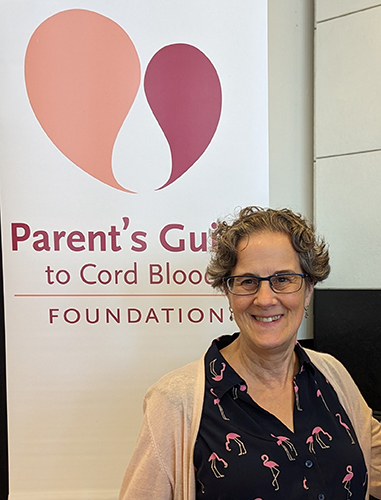
Frances Verter, PhD, earned her PhD in astrophysics from Princeton University in 1983 and conducted research in that field until 1996. Her daughter, Shai, was born in 1992, diagnosed with rhabdomyosarcoma in 1993, successfully treated and later diagnosed with AML in 1996. After undergoing a bone marrow transplant, Shai died in 1997.
Between 1998 and 2007, Verter worked as a computer programmer in a climate modeling group and had two more children. Verter founded the Parent’s Guide to Cord Blood in 1998 in memory of her daughter, Shai. The project began as a website and was later incorporated as a foundation in 2007. Verter has served as the foundation’s CEO ever since.
Now in her third career, Verter says she is trying hard not to start a fourth. She spoke with AABB News about her journey as a scientist and patient advocate, the evolution of cord blood banking and future developments in the field.
AABB NEWS: How did your background as a scientist and patient advocate lead you into the cord blood field?
Verter: I became a patient advocate because I had to be one on behalf of my child. Shai had very diverse ancestry, and it took months to find her a matching bone marrow donor. At that time, public cord blood banks were just starting to build their inventory, and a cord blood transplant was not available. When I became pregnant again, I decided to bank the cord blood for my family because I had learned it could be a lifeline for patients who don’t have adult donors. The research I conducted to pick a family cord blood bank for myself led to the launch of the Parent’s Guide to Cord Blood website.
AABB NEWS: What is a common misconception people have about cord blood banking or about your work in the field?
Verter: Among readers of my website, I often encounter the misconception that I am just a “mommy blogger.” I participate in research, and I publish papers in peer-reviewed medical journals. For example, I was the anchor author on a meta-analysis of cell therapy treatment for COVID-19, which has been downloaded more than 6,600 times and cited 30 times so far.
AABB NEWS: What unique value does cord blood bring to patient care that you believe deserves greater visibility or advocacy?
Verter: It remains true that cord blood transplants are an important option for patients from ethnic minority groups or with mixed ancestry, for whom finding a matched adult donor can be challenging. Cord blood is also especially important for some underserved racial and ethnic populations who are less likely to receive prompt transplant evaluations and therefore often reach transplantation later in their disease. Cord blood transplants are available faster than transplants from adult donors and thus can help these patients to get a transplant promptly. More attention should be given to the role cord blood can play in reducing disparities in transplant access.
AABB NEWS: You support both public donation and family banking of cord blood. What key factors should families consider when deciding between the two?
Verter: These days, the first thing parents should consider is whether they have a choice between public donation and family storage. Most parents do not have the option to donate, because many public cord blood banks have reduced the number of hospitals where they collect, or have stopped collecting new donations altogether. If parents do have the option to donate for transplants, then perhaps they can give the gift of life to a patient in need. Today, most parents only have a choice between banking privately or letting the cord blood be thrown away.
More attention should be given to the role cord blood can play in reducing disparities in transplant access.
AABB NEWS: From your perspective as a scientist and patient advocate, what are the most pressing challenges facing cord blood banking today, and where do you see the greatest opportunities for growth or innovation?
Verter: In my opinion, the greatest challenge facing cord blood today is not a scientific or medical issue. It is bad publicity. There is an ongoing trend among journalists to criticize private cord blood banking. Even when the media shares a positive story about a child who receives a cord blood transplant from a public bank, those transplants are sometimes depicted as a last resort.
AABB NEWS: How has the role of cord blood evolved within transfusion medicine and the biotherapies landscape throughout the past decade?
Verter: Cord blood has gone from being an unmanipulated graft source for transplants to being the starting material for developing multiple types of advanced cell therapies. The 2025 Nobel prize in medicine was awarded for discovering the role that regulatory T-cells (T-regs) play in immune tolerance. Cord blood is the richest source of T-regs, a type of immune cell whose concentration in blood declines with age. Moreover, the T-regs in cord blood have minimal exposure to antigens, and cord blood T-regs are better at maintaining their properties when expanded in culture. This is only one example. Cord blood is also used as a source for therapies that rely on natural killer (NK) cells or CAR-T cells or other cell types.
AABB NEWS: As biotherapies continue to evolve, what hurdles must be addressed to better integrate cord blood into emerging cellular and biotherapies?
Verter: To develop and promote cord blood as a source of biotherapies, cord blood banks need to transition from operating like traditional blood banks to operating more like pharma companies. The industry recently launched an initiative called the Cord Blood Council to tackle that task.
AABB NEWS: AABB recently welcomed former Cord Blood Association members into its community. What does this transition mean for the field, and how can it strengthen collaboration moving forward?
Verter: Personally, I am excited about the ability to meet with a wider range of people at the annual meetings, now that Cord Blood Connect is part of the general AABB Annual Meeting. With AABB providing organizational infrastructure, cord blood experts can focus more on growing the acceptance and applications of cord blood biotherapies.
AABB NEWS: Looking ahead, what developments do you think will most shape cord blood banking in the next five to ten years, and what gives you the most hope about its future?
Verter: Looking ahead, I see two developments which are very encouraging for the cord blood field: one in transplant medicine and the other in regenerative medicine.
In transplant medicine, a couple of recent studies have shown that cord blood can dramatically improve outcomes for patients with the AML type of leukemia. One retrospective study in the United Kingdom showed that cord blood transplants had much better survival than haploidentical transplants for patients with minimal residual disease, and a phase 3 study in China showed that haplo-cord transplants are significantly better than haplo transplants.
In the field of regenerative medicine, 2025 saw the publication of a paper that proved cord blood therapy has a large benefit for the motor skills of children with cerebral palsy. There is still a huge unmet need to run a phase 3 trial of cord blood therapy for cerebral palsy, so that it can get FDA approval, and funding for that trial has been a sticking point for years.
AABB NEWS: You presented several sessions at the 2025 AABB Annual Meeting on opportunities and challenges in cord blood banking. What themes or questions surfaced most often, and what were the key takeaways?
Verter: A theme that emerged from the cord blood sessions was the need for more and better communication about the value of cord blood. I gave a talk about public relations tactics to use when talking to the media. Other speakers presented circumstances where cord blood therapies could improve treatment outcomes. There is a need for more oncologists to be trained to transplant cord blood. To meet that need, the community has launched the National Cord Blood Network, which is run by medical doctors to train medical doctors.
AABB NEWS: What are your favorite leisure activities outside of work?
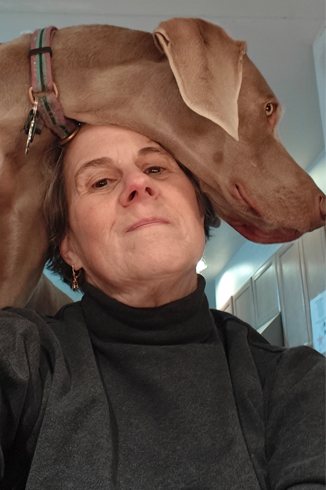
Verter: When I am not working, I try to spend time outdoors every day. On weekdays, I try to go for a long walk with my two dogs—a Weimaraner and a Portuguese Water Dog. This means I have one dog that tolerates heat and another dog that tolerates cold and wet weather, so I always have at least one dog that can go on the walk. If members of AABB run into me at a meeting, they may notice that I almost always wear hiking shoes.
PREVIOUS STORY
In Conversation: Helen Phillips of Gamida Cell on Advancing Cord Blood-Based Cell TherapiesBACK TO ISSUE
February 2026
Transfusion is AABB’s scholarly, peer-reviewed monthly journal, publishing the latest on technological advances, clinical research and controversial issues related to transfusion medicine, blood banking, biotherapies and tissue transplantation. Access of Transfusion is free to all AABB members.
Learn More About Transfusion Journal
Keep abreast of what's happening in the field of biotherapies with CellSource - AABB's monthly update on the latest biotherapies news.

To submit news about the blood and biotherapies field to AABB, please email news@aabb.org.


President
Jose Cancelas, MD, PhD, CABP
Chief Executive Officer
Debra Ben Avram, FASAE, CAE
Chief Communications and Engagement Officer
Julia Zimmerman
Director of Marketing and Communications
Jay Lewis, MPH
Managing Editor
Kendra Y. Mims, MFA
Senior Communications Manager
Drew Case
AABB News
(ISSN 1523939X) is published monthly, except for the combined November/December issue for the members of AABB; 4550 Montgomery Avenue; Suite 700 North Tower; Bethesda, MD 20814.
AABB is an international, not-for-profit association representing individuals and institutions involved in transfusion medicine, cellular therapies and patient blood management. The association is committed to improving health by developing and delivering standards, accreditation and educational programs that focus on optimizing patient and donor care and safety.
+1.301.907.6977
Email: news@aabb.org
Website: www.aabb.org
Copyright 2025 by AABB.
Views and opinions expressed in AABB News are not necessarily endorsed by AABB unless expressly stated.
Notice to Copiers: Reproduction in whole or part is strictly prohibited unless written permission has been granted by the publisher. AABB members need not obtain prior permission if proper credit is given.


4550 Montgomery Avenue
Suite 700, North Tower
Bethesda, MD 20814
301.907.6977