
In 2025, Leuvon and Fauzia van der Leeuw of Switzerland set out to develop a community-focused platform for sickle cell warriors after a close family member shared the challenges of having sickle cell disease (SCD), including chronic fatigue and persistent knowledge gaps in health care settings. After discovering there were no existing apps to help sickle cell warriors better understand patterns in their health, the couple invested their own funds to bring the app to life.
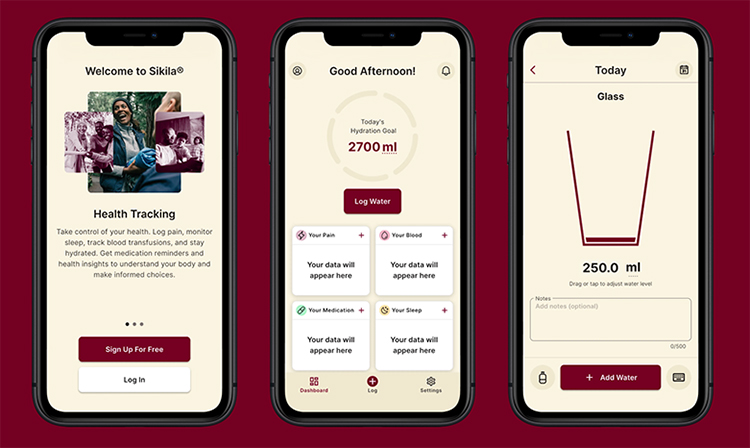
Launched in April 2026, Sikila is a personalized sickle cell companion that helps users track symptoms, medication and hydration, connect with community support and identify potential triggers and warning signs before a sickle cell crisis. The co-founders noted that the app was “built by the community” and shaped directly by warriors, caregivers and clinicians.
“Sikila came out of conversations with people with SCD; we saw the opportunity to create something that could positively impact their lives,” Fauzia said.
The van der Leeuws spoke with AABB News about the inspiration behind the digital platform and their team’s mission to equip warriors with personalized tools to advocate for better care and manage their health.
Fauzia: I assumed there must already be an app for this because there's an app for everything, but I just couldn't find anything. I was genuinely confused, because SCD affects millions of people worldwide.

I went to Leuvon and said, “I think I have an idea.” I still remember holding our daughter while explaining it to him. He immediately said, “Let’s do it.”
That was more than a year ago, and it's been an incredible journey with learning experiences and conversations with people all over the world. We’ve completely bootstrapped the company because we believe in it. We want to keep going. We have big ambitions, but we're not billionaires. We are actively seeking investors who believe in what we're building.
Fauzia: The core goal is to show that through consistent use of Sikila, warriors can experience fewer hospital visits and crises. Ultimately, we want to give people a tool that helps them advocate for themselves, stay well for longer and enjoy a better quality of life.
The app also addresses ease of use. Because it's on your phone, it’s accessible wherever you are in the world. If you're traveling and something happens that requires medical attention, you can pull up Sikila and provide health care providers with a clear understanding of how SCD impacts you specifically. That individual piece is really important to us. We learned early on that this disease presents very differently from person to person, and having a tool that captures that nuance leads to better, more intentional care.
Ultimately, we want to give people a tool that helps them advocate for themselves, stay well for longer and enjoy a better quality of life.” – Fauzia van der Leeuw
For example, someone might discover through the app that certain symptoms consistently appear before a pain crisis, or that a particular medication is causing specific side effects. That information empowers them to have a more meaningful conversation with their clinician about what actually works best for their body.
Even the hydration feature is bespoke. When someone onboards, their hydration goal is calculated based on medically recommended levels for their gender, age, weight and height. It's personalized from the start.
Leuvon: We designed it with the community from the outset. Early on, we started with informal questionnaires and outreach to people we knew who had the condition. They then referred us to others in the community, and we brought them along with us every step of the way — from early black-and-white wireframes and concepts to demo sessions once we had a prototype. We iterated based on people’s feedback and made sure that every feature we built was directly informed by the community. That's something we're proud of. We don't have SCD ourselves, and we're very aware of that. This is a community app built on a community approach, and we'll only succeed and grow with the community's voice.
Fauzia:
Through our research and conversations, we learned that SCD affects people of various demographics and ethnicities. That pushed us to be more targeted in how we reached out, specifically connecting with sickle cell organizations and community spaces. We connected with people from Nigeria to France and everywhere in between, which truly shaped what the app looks like today. Things like language availability (it's currently in English and French) came directly from that input, and we're planning to expand to additional languages and countries.
On the clinical side, we worked with clinicians who reviewed and tested the app and provided insight into issues they commonly discuss with patients and the factors they actively monitor. We designed this app for the entire sickle cell ecosystem — everyone touched by the disease in any way. Their input shaped how the app looks, feels and functions.
The specific features were chosen intentionally...not only because patients told us they wanted them, but because clinicians confirmed that these are important factors they actively monitor when supporting patients with SCD.
Fauzia: It's been incredible. Since the app launched, I've lost count of how many times I've gotten emotional on calls with users. One that really stands out involved a woman describing how her nephew, who has SCD, and his mother always travel with printed copies of his entire medical history — pages and pages of records — just in case something happens on a trip. Knowing that Sikila can replace all of that paperwork and remove the burden is meaningful and really resonates with me. Instead of carrying around physical records, families can have that information accessible in one place wherever they go and have peace of mind.
Fauzia: The hydration tracking feature is probably the one people love most. Users can personalize how they view their intake, but what really resonates is that the hydration goal is calculated based on their personal information. There’s often a moment when people realize, “This app is built for me,” and I love seeing that.
Leuvon: I’m particularly excited about the blood log feature because it's tailored specifically to SCD. Users can track transfusions, side effects and other key health information. The ability to look back and review patterns in pain, hydration, sleep and transfusions over time in detail is priceless.
Leuvon: What excites me most is Sikila’s ability to bridge a gap in health care. So often, someone arrives at the hospital during a crisis, and the history leading up to it gets lost. They may not even be able to recall the details in that moment. Sikila can literally be the bridge between someone's daily life and the care they receive. I think that's powerful.
Fauzia: Looking ahead, we want to help people become more proactive in how they live with SCD through pattern recognition that can help reduce crises and hospital visits and ultimately, create a more equitable conversation between patients and their health care providers.
Leuvon: I want them to feel like they're not pigeonholed by their condition, and that they can use Sikila to enhance their lives and manage this disease rather than feeling defined or defeated by it. Ultimately, I want to enhance people's quality of life.
Fauzia: I echo that completely. I want users to feel empowered during their journey. I want them to be able to live a good quality of life on their own terms, because they have the information they need to make decisions for themselves, rather than always having decisions made for them by a system that doesn't fully understand their experience.
Fauzia: Currently, we're in phase one, which is what users see when they download the app. We want to keep growing, keep building with the community and keep listening to their feedback. This has all been built on the strength of our networks and putting ourselves out there. Neither of us comes from a medical tech background. We just had an idea we believed in and ran with it.
We also see this as a legacy project. We're parents, and one day we'd love for our daughter to look back and understand the impact this had on people's lives. To anyone reading: please reach out if you have feedback or features you'd like to see. We don't claim to be experts. We just want to build with the community.
Leuvon: Agreed. The key words for me are “plugged in” — plugged into people's lives, plugged into the health care system. Wherever Sikila can add value, we should be there. We see this as a health companion: something effortlessly integrated into people's daily lives. That was very deliberate in our design — we wanted the user experience to be as smooth as possible, quality-first.
From a growth perspective, the response has been strong. We had more than 1,400 downloads in the first two weeks, which tells us there's a real appetite for this. The plan is to take what's working, amplify it, make it available to as many people as possible, and keep enhancing it with community-driven features.
Regarding security, Sikila is also both HIPAA- and GDPR-compliant. We built it with privacy in mind from day one because our users' trust is important to us.
Fauzia: I also want to give our team a shout-out. Although Leuvon and I are the co-founders and the faces of Sikila, we have a founding design director, Teju Sanusi, who took everything we described and brought it to life visually, and an incredible chief technology officer advisor, Steven Zgaljic, who helped us build an app that truly works and that people enjoy. We’ve also been joined by Dr. Emmanuel Beckley as clinical lead, who brings deep medical expertise, lived experience with SCD and a strong commitment to improving care. We’re incredibly proud of what we’ve built together.
For more information about the Sikila, download the app at:
BACK TO ISSUE
June 2026
Transfusion is AABB’s scholarly, peer-reviewed monthly journal, publishing the latest on technological advances, clinical research and controversial issues related to transfusion medicine, blood banking, biotherapies and tissue transplantation. Access of Transfusion is free to all AABB members.
Learn More About Transfusion Journal
Keep abreast of what's happening in the field of biotherapies with CellSource - AABB's monthly update on the latest biotherapies news.

To submit news about the blood and biotherapies field to AABB, please email news@aabb.org.


President
Jose Cancelas, MD, PhD, CABP
Chief Executive Officer
Debra Ben Avram, FASAE, CAE
Chief Communications and Engagement Officer
Julia Zimmerman
Director of Marketing and Communications
Jay Lewis, MPH
Managing Editor
Kendra Y. Mims, MFA
Senior Communications Manager
Drew Case
AABB News
(ISSN 1523939X) is published monthly, except for the combined November/December issue for the members of AABB; 4550 Montgomery Avenue; Suite 700 North Tower; Bethesda, MD 20814.
AABB is an international, not-for-profit association representing individuals and institutions involved in transfusion medicine, cellular therapies and patient blood management. The association is committed to improving health by developing and delivering standards, accreditation and educational programs that focus on optimizing patient and donor care and safety.
+1.301.907.6977
Email: news@aabb.org
Website: www.aabb.org
Copyright 2025 by AABB.
Views and opinions expressed in AABB News are not necessarily endorsed by AABB unless expressly stated.
Notice to Copiers: Reproduction in whole or part is strictly prohibited unless written permission has been granted by the publisher. AABB members need not obtain prior permission if proper credit is given.


4550 Montgomery Avenue
Suite 700, North Tower
Bethesda, MD 20814
301.907.6977