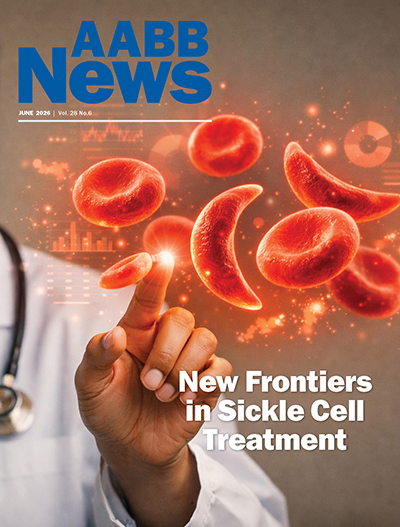
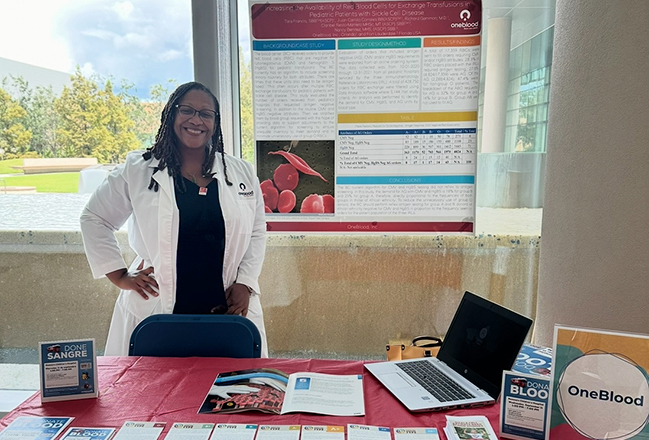
Growing up in a single-parent household, Tara King, MHA, SBB(ASCP), watched her mother navigate sickle cell disease (SCD) while working tirelessly to provide for the family. As a child, King learned to recognize the signs of an impending sickle cell crisis, which often led to countless hours in the emergency room.
“She would try to ignore it because she was tired of being in the hospital and didn’t want to miss work,” King recalled. “Sometimes I would see the veins on her knees branch up like tree branches because of the blockage. I'd say, ‘Mom, you're in pain. You need to go to the hospital,’ and she'd say, ‘No, I don't want to go. I'm fine.’”
King noted that SCD affected nearly every aspect of her family’s life. “My mother didn't have much access to care. The pain never really subsided,” she said. “She couldn't go in the water because it was too cold, so we avoided certain activities. We drove everywhere instead of flying because of low oxygen levels, but long car rides could also trigger a crisis, so we stopped often so she could stretch her legs.”
In 2006, King’s mother passed away due to complications from SCD at age 52. King, who was 22 at that time, said losing her mother to the disease ignited a passion to do more for the sickle cell community. She enrolled in medical technology school the following year, where she discovered her calling in blood banking.
“My mother had received numerous blood transfusions throughout her life, and I witnessed that. When I learned about transfusion reactions in blood banking, I realized my mom had experienced one of those,” she said. “That's when it clicked. I realized I could help people with SCD through this discipline. I chose blood banking because it was near and dear to me. I felt I could be impactful and help others.”
King began her career at OneBlood as a lab assistant in 2008. In her current role as the immunohematology reference lab manager, she oversees a 24-hour operation that finds compatible blood for patients with positive antibody screens, including patients with SCD.
“Patients with SCD often require exchange transfusions, which can mean finding eight to 10 units of antigen-negative blood,” she said. “When a patient's blood type or antigen combination is particularly rare, we work closely with hospitals and physicians to manage blood types and determine next steps, whether that means molecular testing or monolayer assay testing.”
Outside the lab, King spends her time educating patients, parents, caregivers and community members about blood transfusions, antibodies, antigens and the importance of diversity in blood donation to support patients. “One of the most impactful things I do is speak with parents of children who have SCD, explaining what happens behind the scenes before a transfusion, how it helps their child, and how they can be part of the solution as donors and advocates,” she told AABB News.
King emphasized the need for increased blood donations from diverse populations, particularly among those of African descent.
“I wish more people understood how important donor diversity is for transfusions, and how it goes beyond SCD,” King said. “Many people assume that having a large supply of type O blood means we can give it to everyone, but that's not the case. We have more than 300 antigens on our red blood cells, so it’s much more complex than matching ABO blood types,” she said.
I wish more people understood how important donor diversity is for transfusions, and how it goes beyond sickle cell disease.
For King, the biggest transfusion-related challenge facing the laboratory today is finding enough compatible blood products to support transfusion needs. An increase in donations from all populations would provide a solution, she pointed out.
“Sometimes we can provide half the amount a patient needs, but not the full amount because every blood bank in the community is looking for the same units and the supply is limited, especially for pediatric patients,” King explained. “Because patients with SCD are chronically transfused, many have developed antibodies to common antigens, which makes it increasingly difficult to find compatible blood. If we can build a broader, more varied donor base, we'll have the variety of blood needed to fully support our patients.”
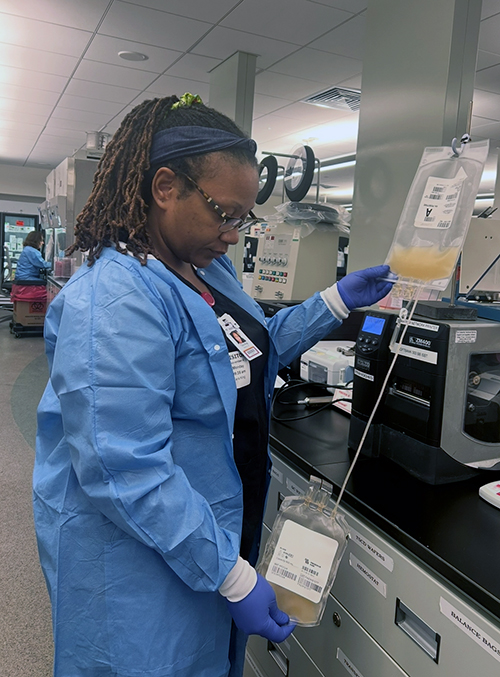
Although King said she never imagined she would become a laboratory manager, she is grateful for the opportunity to honor her mother through her work. When she walked into her interview for the lab assistant role 18 years ago, she knew that this work would always be personal.
“At that time, even organizing the laboratory or alerting a technologist that a patient’s sample had arrived felt like a meaningful contribution,” she said. “I truly feel this career found me. I went to medical technology school because I'm good at science, not fully knowing much about the field. I went through a pharmacology class and thought, this isn't for me. When I learned about blood banking, I knew this is where I’m supposed to be.”
One of King’s greatest rewards is visiting children's hospitals and seeing the impact of her team’s work on patients and their families. “Their lives are better because of the work we do,” she said. “And it's not just me or the blood bank; it's a whole team, from the people separating blood downstairs to those delivering it. Everyone here is deeply passionate and they care.”
King also expressed optimism about the evolution of sickle cell treatment options since her mother’s journey, including advances in gene therapy and bone marrow transplantation. “It makes me smile,” she said. “Growing up, the treatments I knew about were blood transfusions, pain medication and long hospital stays, but now there's gene therapy, and I think that's revolutionary. Gene therapy gives people living with SCD real hope for the future. It’s become that light at the end of the tunnel. Seeing people being cured is honestly a blessing.”
Keeping her mother’s legacy alive motivates King every day. She credits her mother for teaching her about resilience and gratitude amid adversity.
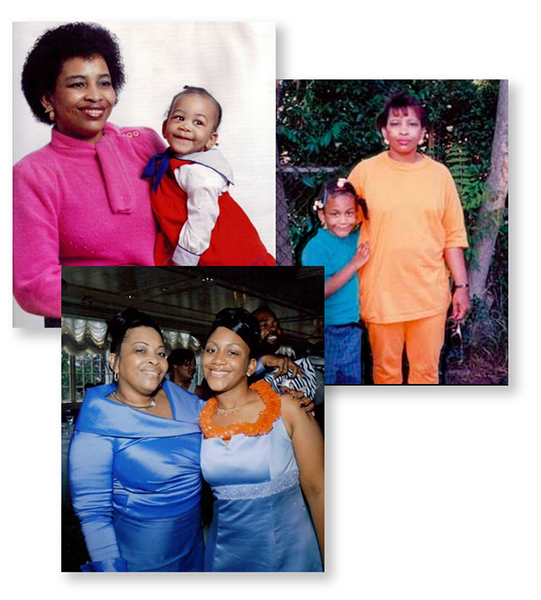
“She didn’t use SCD as an excuse. She knew she had to take care of herself internally because the disease itself was out of her hands,” King said. “She made me realize things could always be worse, and that I should be appreciative of the opportunities I have.”
King added that her mother encouraged her to pursue education and do something purposeful with her life. “She was a stickler on education,” she said. “Watching her graduate from college was something to be truly proud of, because it was hard for her. She would miss days because of her illness and had to start over, all while raising kids on her own. She showed me I could do it, too.”
As someone with the sickle cell trait, King also educates her family members about the importance of knowing their status and understanding how the disease is inherited. King said her mother would be proud of the work she is doing today to improve care for patients with SCD and raise awareness about the disease in the lab and beyond.
“It would have been easy to give up. Every time I see a patient come in with that diagnosis, I could easily fall into, ‘woe is me; I lost my mom.’ But instead, I think about how we can help them,” King said. “My mother knew how emotional I was, and she would commend me for taking that pain and turning it into passion to make a difference.”
Transfusion is AABB’s scholarly, peer-reviewed monthly journal, publishing the latest on technological advances, clinical research and controversial issues related to transfusion medicine, blood banking, biotherapies and tissue transplantation. Access of Transfusion is free to all AABB members.
Learn More About Transfusion Journal
Keep abreast of what's happening in the field of biotherapies with CellSource - AABB's monthly update on the latest biotherapies news.

To submit news about the blood and biotherapies field to AABB, please email news@aabb.org.


President
Jose Cancelas, MD, PhD, CABP
Chief Executive Officer
Debra Ben Avram, FASAE, CAE
Chief Communications and Engagement Officer
Julia Zimmerman
Director of Marketing and Communications
Jay Lewis, MPH
Managing Editor
Kendra Y. Mims, MFA
Senior Communications Manager
Drew Case
AABB News
(ISSN 1523939X) is published monthly, except for the combined November/December issue for the members of AABB; 4550 Montgomery Avenue; Suite 700 North Tower; Bethesda, MD 20814.
AABB is an international, not-for-profit association representing individuals and institutions involved in transfusion medicine, cellular therapies and patient blood management. The association is committed to improving health by developing and delivering standards, accreditation and educational programs that focus on optimizing patient and donor care and safety.
+1.301.907.6977
Email: news@aabb.org
Website: www.aabb.org
Copyright 2025 by AABB.
Views and opinions expressed in AABB News are not necessarily endorsed by AABB unless expressly stated.
Notice to Copiers: Reproduction in whole or part is strictly prohibited unless written permission has been granted by the publisher. AABB members need not obtain prior permission if proper credit is given.


4550 Montgomery Avenue
Suite 700, North Tower
Bethesda, MD 20814
301.907.6977