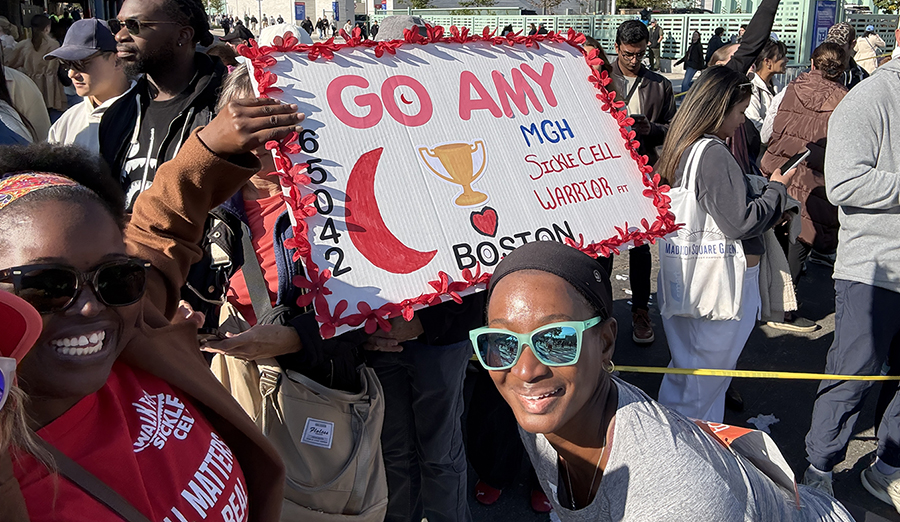
 Amy Cohen, 29, anticipated tears when she completed the New York City Marathon on November 2, 2025, after three years of training for her lifelong dream. But instead, Cohen was stunned into silence as she crossed the finish line that afternoon, making history as the first sickle cell warrior to complete a marathon.
“It was such a huge goal. I had worked toward it, and it took a few years to get there, but to actually finish was shocking,” she said. “It was the opposite of what I thought I would feel. I thought I would be crying and saying, ‘Oh my God, I did it,’ but I was silent.”
Cohen, who finished the 26.2-mile race in 6 hours, 9 minutes and 27 seconds, said she was inspired to run a marathon after learning about Oprah Winfrey’s accomplishment. “I grew up watching Oprah, and I remember one episode where she reflected on running a marathon in Washington, D.C.,” Cohen recalled. “There wasn’t much of a running culture while I was growing up in Houston, so it was inspiring to see another Black woman decide she wanted to run and actually do it.
Cohen ran the marathon with New York Road Runner’s Team Inspire, a group that selects 26 runners to represent each mile of the race and shares their journeys. The experience gave her a platform to raise awareness about sickle cell disease (SCD) and share her unique journey with the inherited blood disorder.
“I grew up not knowing anyone else with the disease. I didn’t have any references, so I didn’t understand how severe the condition could be,” she said. “My medical team at Texas Children’s Hospital always encouraged me to play sports, so I played tennis, volleyball, soccer and other sports, and I never had issues. Having that foundation of being active and not having complications from the disease until I was 14 gave me a different perspective on SCD than other people.”
Cohen was diagnosed with SCD before her birth after prenatal testing confirmed her parents’ concerns that she may have inherited the disease. The early diagnosis allowed her family to establish a comprehensive care team before she was born.
“I’m fortunate that I had access to world-class health care,” Cohen told AABB News. “I already had a physician, hematologist and medical team in place. I never felt like I couldn’t do things because I had SCD. Working in the public health space now, I understand that privilege I had, because health insurance is a privilege.”
Cohen described her first sickle cell crisis – at age 14 – as the scariest moment in her life. She woke up in the middle of the night screaming from excruciating upper back pain. As the only family member with SCD, her painful episode confused her parents.
“Nothing could have prepared me for that. I thought I was dying,” she said. “It was throbbing pain, and it was odd because it wasn’t something I could press on and feel. It felt very internal.”
Cohen had a brief hospital stay where she received IV fluids and pain medication. Unfortunately, that was just the beginning. She experienced a crisis every month from September to March, and it continued that way for three years.
“At one point, I didn’t think I would graduate high school because of how sick I was,” she said.
During that time, Cohen discussed three treatment options with her care team: blood transfusion, stem cell transplant and hydroxyurea. She ultimately chose hydroxyurea because it was the least invasive option.
“I’m forever grateful for hydroxyurea, a once-a-day pill that helps create fetal hemoglobin to help with crises,” she said. “I started taking it, and after a couple of months, I stopped having crises. I went through an eight-year period without a crisis, which was the best thing ever.”
After moving to Boston in 2023, Cohen found Sharl Azar, MD, a hematologist at the Massachusetts General Hospital and Harvard Medical School, and the medical director of the Comprehensive Sickle Cell Disease Treatment Center. She said Azar helped her manage her medical condition and introduced her to exercise specialist Jen Miramontes.
“I cry almost every time I talk about Dr. Azar because he is so wonderful. He created a beautiful, comprehensive sickle cell program,” she said. “People with SCD need specialists who are knowledgeable about the condition. I’ve run into many providers who say their only interaction with SCD was in medical school or residency. I needed someone who understood the condition so it could be a partnership, rather than me coaching them through my condition. Dr. Azar alleviated my concerns.”
People with SCD need specialists who are knowledgeable about the condition.
Cohen shared her lofty goal to run the New York City marathon during her Zoom consultation with Miramontes. “I just blurted it out without thinking,” Cohen said. “I thought Jen's connection had frozen because she got so still. I talked about my background and that I played sports when I was younger. She was genuinely impressed, because to her that is not the norm for patients with SCD.”
With Dr. Azar’s approval, Miramontes and Cohen developed a plan to train safely. Although they were unable to secure entry into the New York City Marathon in 2023, Cohen ran the Boston Half-Marathon with Miramontes instead, marking her first long-distance race.
“I hadn’t even run a 5K before that half marathon,” she said. “As we were running, I saw the distance markers and thought, ‘It would have been a good idea to run a 5K first,’ but there we were, running 13.1 miles.”
Despite her athletic background, Cohen had to carefully manage her training approach for the race, since high-intensity training and vigorous exercises can trigger pain crises for patients with SCD.
“SCD is an invisible illness, so we never look the way we feel,” Cohen said. “I am always tired – always tired. But I have to pull myself up and continue to do what I need to do to accomplish my goals.”
Cohen's training consisted of three-mile runs during the week and one long-distance run on the weekend. The longer runs required more rest and hydration for a smoother recovery.
 “I was okay until I got to my 20-mile runs. I thought I was going to have a crisis,” she said. “It was scary, and I realized I had to switch up my strategy. I skipped Gatorade and liquid IV and drank an entire bottle of Pedialyte after races and after running. But I finished the race, and the most beautiful thing about it is that I did not get sick. I’m very grateful for that.”
The Power of Resilience
Cohen hopes that her historic milestone helps change perceptions of the sickle cell community and challenges common misconceptions about warriors. She believes people with SCD should not be defined by physical limitations.
“There are so many accomplished warriors who are going to school, starting businesses, having families and doing amazing things,” she said. “I feel like people don’t pay attention to that because the perception is that we are these unfortunate, bed-ridden people who don’t have anything going on besides worrying about pain.”
She added that SCD treatment is not one-size-fits-all, and every patient has their own recipe that works for them.
“I’m glad SCD is getting more attention. People are starting to understand that it is a complex condition,” she said. “The disease can be such a burden on patients and their support systems. But today, people who could not keep a job or finish school and were always in the hospital are undergoing gene therapy and coming out on the other side with a new lease on life. It’s the most beautiful thing.”
Since her groundbreaking achievement, Cohen has received inspiring messages from warriors around the world. Her marathon journey has given other warriors hope and inspires them to pursue their goals. Her message to the sickle cell community is this: “If I can do it, you can too.”
“I’m not some special snowflake who was ordained with this situation. I still had to work every day, and I prioritized my goal. It was a lot, and it took three years to get there,” Cohen said. “Achieving this milestone means a lot in ways that I can’t really articulate. But the fact that I could run a marathon in that specific season of life showed me the power of resilience and self-belief.”
PREVIOUS STORY
Decisions About Best Options for Sickle Cell Disease Management Are Highly IndividualizedBACK TO ISSUE
June 2026
Transfusion is AABB’s scholarly, peer-reviewed monthly journal, publishing the latest on technological advances, clinical research and controversial issues related to transfusion medicine, blood banking, biotherapies and tissue transplantation. Access of Transfusion is free to all AABB members.
Learn More About Transfusion Journal
Keep abreast of what's happening in the field of biotherapies with CellSource - AABB's monthly update on the latest biotherapies news.

To submit news about the blood and biotherapies field to AABB, please email news@aabb.org.


President
Jose Cancelas, MD, PhD, CABP
Chief Executive Officer
Debra Ben Avram, FASAE, CAE
Chief Communications and Engagement Officer
Julia Zimmerman
Director of Marketing and Communications
Jay Lewis, MPH
Managing Editor
Kendra Y. Mims, MFA
Senior Communications Manager
Drew Case
AABB News
(ISSN 1523939X) is published monthly, except for the combined November/December issue for the members of AABB; 4550 Montgomery Avenue; Suite 700 North Tower; Bethesda, MD 20814.
AABB is an international, not-for-profit association representing individuals and institutions involved in transfusion medicine, cellular therapies and patient blood management. The association is committed to improving health by developing and delivering standards, accreditation and educational programs that focus on optimizing patient and donor care and safety.
+1.301.907.6977
Email: news@aabb.org
Website: www.aabb.org
Copyright 2025 by AABB.
Views and opinions expressed in AABB News are not necessarily endorsed by AABB unless expressly stated.
Notice to Copiers: Reproduction in whole or part is strictly prohibited unless written permission has been granted by the publisher. AABB members need not obtain prior permission if proper credit is given.


4550 Montgomery Avenue
Suite 700, North Tower
Bethesda, MD 20814
301.907.6977