
José Arnulfo Pérez-Carrillo, MD, PhD, MHA, EMTACT, is a Colombian physician-scientist specializing in transfusion medicine, blood banking, pathology, epidemiology and health systems management. He serves as medical director of the blood bank and transfusion services at Clínica Colsanitas in Bogotá and is affiliated with teaching programs at the National University of Colombia and Pontificia Universidad Javeriana.
Pérez-Carrillo is currently pursuing a PhD in infectious diseases at Universidad de Santander (UDES). He is active in AABB, the International Society of Blood Transfusion (ISBT), the Grupo Cooperativo Iberoamericano de Medicina Transfusional (GCIAMT) and the Asociación Colombiana de Bancos de Sangre y Medicina Transfusional (ACOBASMET). He has published articles on donor screening, patient blood management (PBM), transfusion quality and operational improvement in blood services. In addition, he serves as the co-leader of the AABB Spanish Language Subsection.
Pérez-Carrillo spoke with AABB News about his efforts to advance blood safety in Colombia and the key to translating hemovigilance data into meaningful change.
AABB NEWS: Who or what influenced your career path in transfusion medicine and biotherapies, and how did your path lead to your current role?
Pérez-Carrillo: My career has been at the intersection of laboratory medicine meets direct patient care. Training in anatomic pathology, clinical pathology, digital transformation in health care, public health focused on the management of viral tropical endemics and outbreaks, clinical epidemiology and health administration taught me that blood safety is not only a technical issue; it is also a systems issue. Over time, this led me to transfusion medicine, where donor safety, product quality, traceability and clinical decision-making must work together. That path eventually brought me to my current role as medical director of the blood bank and 13 transfusion services at Clínica Colsanitas in Colombia, while remaining active in teaching, research and international professional collaboration.
AABB NEWS: Can you tell us about your background and how your work is advancing blood safety in Colombia?
Pérez-Carrillo: I am a Colombian physician-scientist with more than 25 years of experience in transfusion medicine, blood bank management, clinical laboratories and academic research. My work has focused on building safer and more consistent transfusion systems through quality management, infectious disease screening, hemovigilance and PBM. In practical terms, this includes leading a Colombian hospital blood bank network, supporting transfusion services, strengthening donor screening and helping align practice with AABB standards.
AABB NEWS: What is the biggest challenge in ensuring safe and consistent transfusion practices across institutions in Colombia and the broader Latin American region?
Pérez-Carrillo: The biggest challenge is heterogeneity. Many hospitals are deeply committed to blood safety, but they do not all operate with the same level of documentation, traceability, process validation, audit culture or clinical governance. That variability creates preventable risk. In Latin America, the issue is not only access to blood components, but whether the system can ensure that blood is collected, processed, distributed and used under consistent standards.
AABB NEWS: Where do you still see gaps in current safety systems, whether in hemovigilance, donor screening or transfusion practices? Where do you see the most progress?
Pérez-Carrillo: I still see gaps in the translation of safety data into operational change. Hemovigilance data are often collected, but not always converted to bedside decisions, protocol revisions or corrective actions. I also believe there is room for wider standardization in advanced donor screening strategies and in the consistency of transfusion thresholds
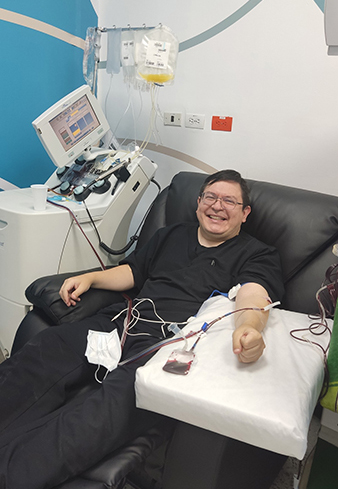 At the same time, I see real progress in Colombia: the national blood system is mature, voluntary donation remains strong and many institutions are increasingly focused on quality systems, traceability and patient-centered transfusion practice. Finally, I am developing an application prototype with a group of engineers, a blockchain-based application for hemovigilance, seeking to apply the AABB standards to strengthen traceability and transfusion safety.
AABB NEWS: How can organizations translate hemovigilance data into meaningful change at the bedside?
Pérez-Carrillo: They have to move from passive reporting to active governance. That means reviewing reaction patterns, near misses and delays in real time; linking those findings to transfusion committees; and using them to improve indications, storage, traceability, turnaround times and staff training. Hemovigilance becomes meaningful only when it drives protocol updates, feedback to general practitioners and specialist physicians and measurable corrective and preventive actions.
Whether we are caring for a patient with cancer, a child, a pregnant woman with severe hemorrhage or a critically ill adult, our responsibility is not only to provide safe blood, but to preserve dignity, compassion, and trust throughout the process.
AABB NEWS: You have worked extensively in accreditation and PBM. How can accreditation be used to improve consistency and quality across transfusion practices?
Pérez-Carrillo: Accreditation helps because it creates a common operating language. AABB standards require structured quality systems, document control, competency assessment, process validation, auditing and continuous improvement. The current AABB Standards for a Patient Blood Management Program are in the 5th edition and became effective on June 1, 2025. They define PBM as encompassing patient evaluation and clinical management surrounding transfusion decision-making, including appropriate indications, minimization of blood loss and optimization of patient red cell mass. In my view, accreditation provides the structure, and PBM provides the clinical discipline. Together, they reduce unwarranted variability and support safer, more appropriate transfusion care.
AABB NEWS: You have contributed to research on PBM, donor screening and transfusion safety. What findings or areas of research have had the greatest impact on your work?
Pérez-Carrillo: Three areas have influenced me the most. First, donor screening research—especially work related to anti-HBc and occult hepatitis B infection—has reinforced how important it is to think beyond minimum compliance and focus on residual risk. Second, research on PBM has strengthened my commitment to restrictive, evidence-based transfusion practice. Third, operational studies on platelet wastage, quality control and workflow improvement have shown me that blood safety also depends on logistics, process design and data use. One of the most meaningful recognitions in that journey was seeing our Transfusion-published work on anti-HBc and occult hepatitis B acknowledged by Wiley as a top-cited article.
AABB NEWS: What professional accomplishment are you most proud of and why?
Pérez-Carrillo: I am most proud of helping to build a hospital-based blood bank model that combines donor safety, transfusion support, quality systems and academic work. In our network, the blood bank has supported multiple transfusion services across several Colombian cities, implemented nucleic acid testing (NAT) for all accepted blood donors since May 2022 and developed a strong technical platform for immunohematology and transfusion support. More recently, within the Keralty Group Colombian health care network, the AABB accreditation roadmap for the hospital blood bank (Blood Collection) and the transfusion services in the Clínica Reina Sofía complex at Bogotá DC, have helped organize this work around quality, traceability and PBM principles.
AABB NEWS: What advice do you have for those pursuing a career in transfusion medicine and biotherapies who want to make an impact on blood safety?
Pérez-Carrillo: Stay interdisciplinary. Blood safety is never only a laboratory issue or a clinical issue. Learn quality systems, understand data, respect standards and remain close to patients and frontline teams. Also, build internationally, but implement locally. The best professionals in this field are those who can translate evidence into workable systems in their own institutions.
AABB NEWS: Tell us about a recent book that inspired you.
Pérez-Carrillo: One book that deeply influenced me is Twelve Patients: Life and Death at Bellevue Hospital by Eric Manheimer. I read it during the first wave of COVID-19 in Colombia, between April and June 2020, during a time when uncertainty, scarcity and human vulnerability were especially visible in health care. What stayed with me is that Manheimer does not write about patients as diagnoses or hospital events, but as whole human beings shaped by fear, dignity, inequality and hope. That perspective strengthened my own humanism as a blood bank director. In transfusion medicine, it is easy to focus on components, inventories, compatibility and safety metrics—all of which are essential—but the book reminded me that every unit of blood also belongs to a human story: a donor who gives, a team that safeguards and a patient who depends on that act to continue living.
That lesson has remained central in my work in Colombia. It has helped me see transfusion support not only as a technical process, but as an ethical encounter. Whether we are caring for a patient with cancer, a child, a pregnant woman with severe hemorrhage or a critically ill adult, our responsibility is not only to provide safe blood, but to preserve dignity, compassion, and trust throughout the process. That is the kind of medicine I continue to aspire to practice and lead.
BACK TO ISSUE
May 2026
Transfusion is AABB’s scholarly, peer-reviewed monthly journal, publishing the latest on technological advances, clinical research and controversial issues related to transfusion medicine, blood banking, biotherapies and tissue transplantation. Access of Transfusion is free to all AABB members.
Learn More About Transfusion Journal
Keep abreast of what's happening in the field of biotherapies with CellSource - AABB's monthly update on the latest biotherapies news.

To submit news about the blood and biotherapies field to AABB, please email news@aabb.org.


President
Jose Cancelas, MD, PhD, CABP
Chief Executive Officer
Debra Ben Avram, FASAE, CAE
Chief Communications and Engagement Officer
Julia Zimmerman
Director of Marketing and Communications
Jay Lewis, MPH
Managing Editor
Kendra Y. Mims, MFA
Senior Communications Manager
Drew Case
AABB News
(ISSN 1523939X) is published monthly, except for the combined November/December issue for the members of AABB; 4550 Montgomery Avenue; Suite 700 North Tower; Bethesda, MD 20814.
AABB is an international, not-for-profit association representing individuals and institutions involved in transfusion medicine, cellular therapies and patient blood management. The association is committed to improving health by developing and delivering standards, accreditation and educational programs that focus on optimizing patient and donor care and safety.
+1.301.907.6977
Email: news@aabb.org
Website: www.aabb.org
Copyright 2025 by AABB.
Views and opinions expressed in AABB News are not necessarily endorsed by AABB unless expressly stated.
Notice to Copiers: Reproduction in whole or part is strictly prohibited unless written permission has been granted by the publisher. AABB members need not obtain prior permission if proper credit is given.


4550 Montgomery Avenue
Suite 700, North Tower
Bethesda, MD 20814
301.907.6977