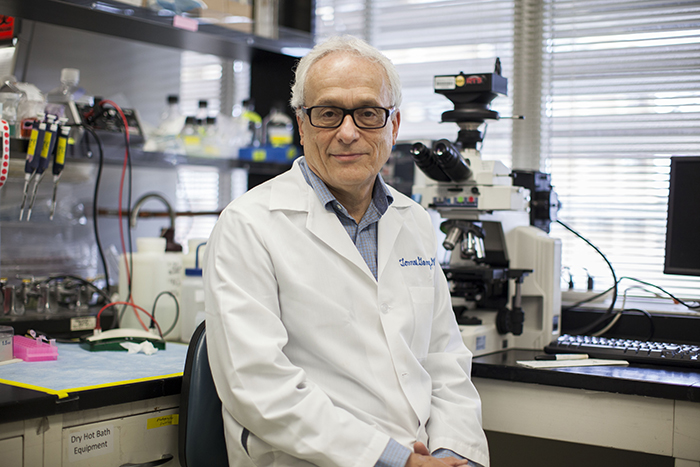
Tomas Ganz, MD, PhD, distinguished research professor of medicine and pathology at the University of California, Los Angeles, received AABB’s prestigious 2025 Landsteiner-Alter Award. His thought-provoking lectureship at the recent AABB Annual Meeting focused on the physiology of iron regulation and its principal disorders and highlighted the role of hepcidin and ferroportin as the endocrine dyad that controls the absorption and distribution of iron.
AABB News caught up with the world-renowned scientist after the 2025 Annual Meeting to discuss his research journey, including his discoveries of the iron-regulatory hormones hepcidin and erythroferrone.
Ganz shared that he stumbled upon the study of iron regulation by accident while researching innate immunity in the 1990s, when he and his team identified a previously unknown small peptide, which they named hepcidin. At that time, Ganz had no way of knowing that this finding would revolutionize the study of iron biology and eventually transform treatment options for patients with iron deficiency anemia.
“We didn’t know what the peptide did, but we and others soon slowly dissected the connection between hepcidin and iron,” he said. “We figured out that this new peptide was something that people had been looking for for many years. It was the hormone that regulates the amount of iron in the body.”
Although Ganz had very little knowledge of iron in the beginning, he noted that his background as an immunologist helped him approach the research with an open mind. “I came into it with a clean slate. I wasn’t burdened by the prevailing assumptions of the field or about how things worked,” he said. “Every week brought a new discovery about how hepcidin worked and how it regulated iron. It truly began as an accident, but we pursued it, and it opened a completely new area for us.”
By 2000, Ganz shifted his lab’s focus entirely to iron regulation. He reflected on the early years of research with enthusiasm, comparing the moment of his scientific breakthrough to falling in love.
“Those early years were incredibly exciting. I was completely absorbed. I couldn’t sleep. Every morning, I woke up eager to see what new insight the day would bring. I read books constantly, trying to understand the connections. It was feverish in the best sense,” he recalled. “We knew our discovery was important, and others were also interested in studying it. The field was brand new to us, so there was a lot to learn. Those were very exciting times; I wouldn’t trade them for anything.”
Ganz’s scientific discoveries have benefited millions of patients worldwide. He noted that the most gratifying aspect of his career is seeing the work applied to patient care. “I love the science and the thrill of discovery, but ultimately, improving patients’ lives is what matters most,” he told AABB News.
With a research career spanning more than 40 years, Ganz’s findings have led to new treatments and targeted therapies for anemia, as well as diagnostics for conditions like hemochromatosis. He explained that there are therapies in development for various blood disorders that either block hepcidin’s action (useful in treating certain anemias) or mimic it, which is helpful in conditions with excessive red blood cell production, such as polycythemia vera. The latter therapeutics are the most advanced and may receive approval within the next few years, he added.
“Whenever a new hormone or bioactive molecule is discovered, it opens the door to developing new medications and diagnostic tools, and hepcidin is no exception,” he said. “We now have diagnostics based on measuring levels of this hormone, which makes it easier to evaluate complex cases of hemochromatosis or anemia by determining whether the hormone is present in excess or in deficiency. Having too much hepcidin causes anemia, while having too little causes iron overload (hemochromatosis). Progress hasn’t been as fast as I once hoped, but it has been steady, and the research is certainly ongoing.”

Meghan Delaney, DO, MPH, and Tomas Ganz, MD, PhD, recipient of AABB’s prestigious 2025 Landsteiner-Alter Award.
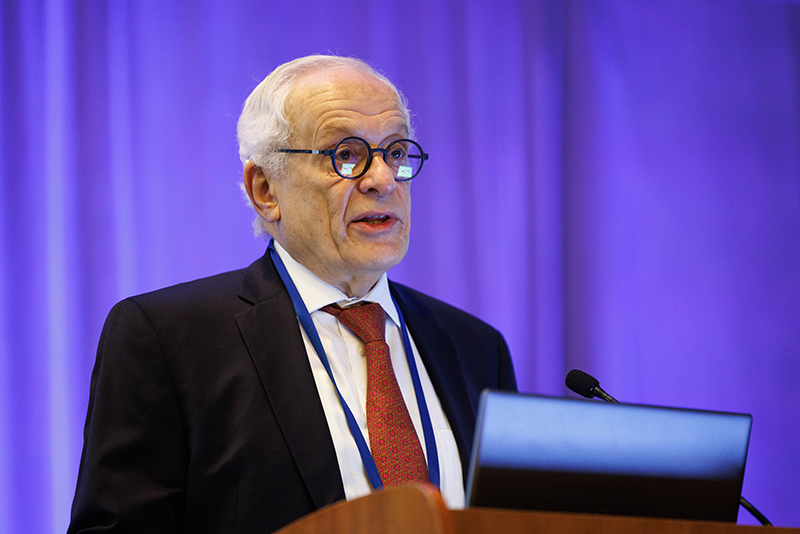
Ganz delivered a thought-provoking lectureship at the recent AABB Annual Meeting on the physiology of iron regulation.
Ganz noted that clinicians often misunderstand how hepcidin works as an inhibitor of iron absorption and release—it decreases iron absorption from the intestine and blocks iron release from stores and from macrophages that recycle old red cells. “I often tell clinicians that hepcidin is to iron what insulin is to glucose. Insulin lowers blood glucose; hepcidin lowers the iron in the blood. That analogy helps clarify how the system works,” he said.
Among the numerous iron-related conditions Ganz has studied throughout his career, he cited the diagnosis of hemochromatosis as the most misunderstood issue in clinical medicine. He explained that diagnosing hemochromatosis requires both elevated ferritin levels and elevated transferrin saturation, while also excluding hematological conditions like thalassemia or other iron-loading anemias.
“We essentially have two measures of iron status: iron levels in plasma, including transferrin saturation, and iron stores, measured by serum ferritin,” Ganz said. “Often times, clinicians will assume a patient has iron overload, but they only use one of these two measures. Elevated ferritin levels alone do not indicate iron overload, as the most common cause of high ferritin is inflammation and metabolic disease rather than iron overload/hemochromatosis.”
As a longtime mentor and educator, Ganz advises young and emerging scientists to align their clinical work with their research to maintain a more fulfilling and sustainable career, a lesson he wished he learned earlier in his own professional journey.
“I trained as a pulmonologist, but my research moved in a different direction, creating tension between my clinical responsibilities and laboratory work. Eventually, I had to choose, and I chose to fully focus on my lab. If your clinical and research interests are aligned, you can sustain both,” he pointed out. He also encourages the next generation of scientists to remain open to unexpected opportunities. “You never know where an unexpected lead can take you,” he added. “Don’t focus solely on the problem you initially set out to solve. Be willing to pursue a new direction if something potentially more important appears. That advice has served me well.”
“I love the science and the thrill of discovery, but ultimately, improving patients’ lives is what matters most.”
Ganz spoke to AABB News about his proudest achievement to date: the discovery of erythroferrone, which he developed in collaboration with a young French scientist, Léon Kautz. Erythroferrone is produced by erythroblasts and tells the system that red blood cell production is increasing and requires more iron. This hormone plays a vital role in regulating iron levels in the body by suppressing hepcidin, the first iron-regulatory hormone Ganz discovered.
“People often say you can make one important discovery by chance, and I would say the discovery of hepcidin had a strong element of that,” Ganz said. “But in some sense, erythroferrone was the most gratifying discovery because it was a deliberate and planned effort to find a hormone we believed existed, one that signaled red blood cell precursors’ need for iron. It wasn’t discovered by chance. The two of us pursued this particular new hormone with a plan, and that plan turned out to be right.”
He added that he is equally proud of the many young scientists who trained in his laboratory and have gone on to successful careers. “Their success means a great deal to me,” he said.
Ganz expressed his gratitude to AABB for being named this year’s Landsteiner-Alter Award recipient. He emphasized the importance of recognizing the contributions within the blood and biotherapies community that may go unnoticed in the health care sector.
“This is not a field that is intrinsically very glamorous,” Ganz said. “It doesn’t attract the attention of cancer or Alzheimer's research, and it's not an area that receives a lot of publicity. It means a lot that the work we are doing is being recognized and appreciated. This award honors not just me, but all the people who have contributed to this field and to my laboratory. I appreciate AABB for recognizing them as well.”
PREVIOUS STORY
Greetings from the New AABB PresidentBACK TO ISSUE
November/December 2025NEXT STORY
Highlights from the 2025 AABB Annual Meeting
Transfusion is AABB’s scholarly, peer-reviewed monthly journal, publishing the latest on technological advances, clinical research and controversial issues related to transfusion medicine, blood banking, biotherapies and tissue transplantation. Access of Transfusion is free to all AABB members.
Learn More About Transfusion Journal
Keep abreast of what's happening in the field of biotherapies with CellSource - AABB's monthly update on the latest biotherapies news.

To submit news about the blood and biotherapies field to AABB, please email news@aabb.org.


President
Jose Cancelas, MD, PhD, CABP
Chief Executive Officer
Debra Ben Avram, FASAE, CAE
Chief Communications and Engagement Officer
Julia Zimmerman
Director of Marketing and Communications
Jay Lewis, MPH
Managing Editor
Kendra Y. Mims, MFA
Senior Communications Manager
Drew Case
AABB News
(ISSN 1523939X) is published monthly, except for the combined November/December issue for the members of AABB; 4550 Montgomery Avenue; Suite 700 North Tower; Bethesda, MD 20814.
AABB is an international, not-for-profit association representing individuals and institutions involved in transfusion medicine, cellular therapies and patient blood management. The association is committed to improving health by developing and delivering standards, accreditation and educational programs that focus on optimizing patient and donor care and safety.
+1.301.907.6977
Email: news@aabb.org
Website: www.aabb.org
Copyright 2025 by AABB.
Views and opinions expressed in AABB News are not necessarily endorsed by AABB unless expressly stated.
Notice to Copiers: Reproduction in whole or part is strictly prohibited unless written permission has been granted by the publisher. AABB members need not obtain prior permission if proper credit is given.

4550 Montgomery Avenue
Suite 700, North Tower
Bethesda, MD 20814
301.907.6977