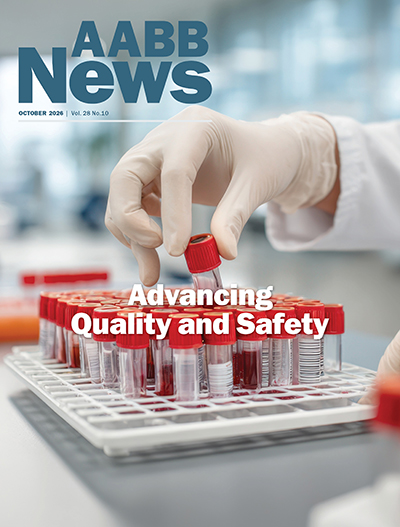

It has been 70 years since AABB took the first steps toward setting standards that optimize and advance quality and safety for the blood and biotherapies field, and its work toward that goal has not stopped since.1,2
Those first standards, Standards for a Transfusion Service, took a different approach from governmental regulatory agencies by focusing on “medical and technical processes and administration of blood to the patient.” Today, AABB and its volunteer members who serve on its Standards Committees have published standards addressing a wide range of areas in the field, including cellular therapy services, immunohematology reference laboratories, and perioperative autologous blood collection and administration.
AABB’s Standards Program has evolved since its first publication decades ago and continues to respond to advancements in the field. What remains constant is that AABB Standards detail requirements that must be implemented by any AABB-accredited facility and are designed to advance the highest levels of quality and safety for donors and patients.3

“AABB standards are really critical in ensuring that facilities have the right structure or processes in place to protect the safety of the product, the patient and the donors,” said Katherine S. Brown, PhD, director, Life Sciences Research and Development at CooperSurgical, Inc. “To me, it is about the integrity and safety of everything that is happening from the very beginning to the very end in these settings.”
Each one of AABB’s Standards is developed by a team of experts and based on best medical practice, scientific data, principles associated with good manufacturing practices and quality assurance, and any applicable regulations.3
“The standard is really the goal post, the ultimate for what the community should expect,” said J. Wade Atkins, MS, MLS, SBB, CQA, CABP(H), a supervisor of quality assurance and regulatory affairs within the Department of Transfusion Medicine at the National Institutes of Health. “The experts of the Standards Committees are not only developing this guidance but also thinking about how the community will be implementing and applying it to real-world situations.”
Many of the standards put forth by AABB have been a staple of the field for years, if not decades. The Cellular Therapy Services Standards recently published its 12th edition, the Immunohematology Reference Laboratories standards its 14th edition, and the Blood Banks and Transfusion Services (BBTS) Standards its 35th edition.
Others are newly developed. Both the Emergency Prehospital and Scheduled Out-of-Hospital Transfusion Standards and the Cell and Gene Therapy Standards for Pharmacy are currently in their first edition.
“The standard is really the goal post, the ultimate for what the community should expect.” – J. Wade Atkins, MS, MLS, SBB, CQA, CABP(H).
Eric Bank, LP, NRP, FAEMS, the assistant chief of EMS for Harris County, Texas, serves on an AABB Standards Committee and helped develop the Emergency Prehospital and Scheduled Out-of-Hospital Transfusion standards. In February 2016, Harris County initiated the first ground whole blood prehospital transfusion program. Ten years later, the Prehospital Blood Transfusion Coalition estimated that more than 400 ground EMS agencies carried blood products.4
“AABB recognized this growth and the need to get standards into this space, taking two very, very, very different forms of medicine – transfusion medicine and emergency services—and figuring out how to combine them,” Bank said.

AABB had existing Standards for Out-of-Hospital Transfusion Administration Services, but they focused more on dialysis centers, nursing homes or long-term care facilities.5 Bank was part of a group that worked to develop standards for this brand-new space.
“The gold standard is always the Standards for Blood Banks and Transfusion Services, so we had to take those standards and carve them into a true prehospital space, understanding that some of the things required have to be done in a different way,” Bank said.
For example, the standards call for two ABO determinations to be performed. The first determination should be performed on a current sample, and the second can occur by comparing to previous records, testing a second sample collected at a different time, or retesting.
“We had to figure out a way to adjust these different models but stay true to the BBTS standard,” Bank said. For example, blood re-typing cannot be performed in the field by EMS. Without a lab to accomplish this, the re-typing is being done by local blood banks—such as by South Texas Blood and Tissue in San Antonio and Gulf Coast Regional Blood Center in Houston—prior to product delivery.
Similarly, Brown worked to help develop the Cell and Gene Therapy Standards for Pharmacy, which established quality systems for specialty pharmacies that dispense approved cell and gene therapy products.6
“These standards began with observation of the field and where the field was going,” Brown said. “AABB identified that there was accreditation and standards, but they weren’t well suited for the different environment of the pharmacy. The pharmacy world is responsible for parts of the process that don’t necessarily overlay with where the existing cell therapy standards were.”
Each set of standards, whether new or old, is effective for two years. For example, Bank and colleagues are already working to finalize the second edition of Standards for Out-of-Hospital Transfusion Administration Services.
“Nothing is static,” Atkins said. “Things are constantly changing related to the science developed, implementing new ideas, who to treat and how we can do better for donors and patients.”
When it comes time to update a set of standards, Brown said that feedback is vital. Part of the review process also includes looking at the number and content of variance requests. Variances are alternate methods of achieving the intent of the standard.
“If we see a large number of institutions are requesting a variance, that tells us something about what we have written,” Brown said. “Have things changed? Is the standard no longer applicable?”
The Committee is then tasked with going through the standards line by line to see what needs to be corrected or updated. A new committee volunteer may bring a fresh perspective to how something is worded, or whether a standard is overly prescriptive.
Prior to final publication, each new set of standards is opened for public comment. The committee reviews all comments submitted and provides a summary document that describes the committee’s rationale for its final decisions.

The final and most important part of the creation of any new set of standards is implementation.
“Nothing has value until someone can use it,” Atkins said.
Today, there are AABB-accredited facilities in more than 50 countries. To maintain accreditation, facilities must comply with the most current edition of Standards. Gaining and maintaining accreditation raises the level of trust that patients, donors and other stakeholders have in the facility.
“There are several mechanisms that help with implementation,” Atkins said. “For example, each set of standards had a companion document that details the changes, and there are often presentations or webinars detailing changes to standards.”
Atkins emphasized that the people who volunteer on the Standards Committees are also genuinely interested in seeing best practices filter down throughout the field.
“Committees work to develop their best approaches to what the community should be doing in these subject areas,” Atkins said, “then those seeking accreditation have a duty to understand and implement those standards if they want a positive assessment worthy of AABB accreditation.”
BACK TO ISSUE
October 2026NEXT STORY
A Year of Progress
Transfusion is AABB’s scholarly, peer-reviewed monthly journal, publishing the latest on technological advances, clinical research and controversial issues related to transfusion medicine, blood banking, biotherapies and tissue transplantation. Access of Transfusion is free to all AABB members.
Learn More About Transfusion Journal
Keep abreast of what's happening in the field of biotherapies with CellSource - AABB's monthly update on the latest biotherapies news.

To submit news about the blood and biotherapies field to AABB, please email news@aabb.org.


President
Jose Cancelas, MD, PhD, CABP
Chief Executive Officer
Debra Ben Avram, FASAE, CAE
Chief Communications and Engagement Officer
Julia Zimmerman
Director of Marketing and Communications
Jay Lewis, MPH
Managing Editor
Kendra Y. Mims, MFA
Senior Communications Manager
Drew Case
AABB News
(ISSN 1523939X) is published monthly, except for the combined November/December issue for the members of AABB; 4550 Montgomery Avenue; Suite 700 North Tower; Bethesda, MD 20814.
AABB is an international, not-for-profit association representing individuals and institutions involved in transfusion medicine, cellular therapies and patient blood management. The association is committed to improving health by developing and delivering standards, accreditation and educational programs that focus on optimizing patient and donor care and safety.
+1.301.907.6977
Email: news@aabb.org
Website: www.aabb.org
Copyright 2025 by AABB.
Views and opinions expressed in AABB News are not necessarily endorsed by AABB unless expressly stated.
Notice to Copiers: Reproduction in whole or part is strictly prohibited unless written permission has been granted by the publisher. AABB members need not obtain prior permission if proper credit is given.


4550 Montgomery Avenue
Suite 700, North Tower
Bethesda, MD 20814
301.907.6977