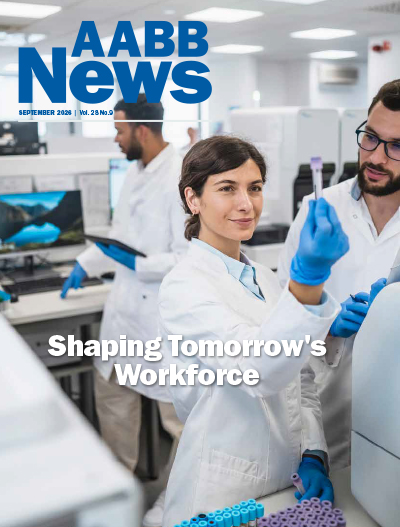

Mentorship plays a vital role within the AABB community, helping to ensure the next generation of leaders in blood and biotherapies are prepared for challenges and ready to support advancement of the field.
The AABB Mentoring Program pairs experienced AABB members with colleagues who have worked in blood banking, transfusion medicine or biotherapies for less than five years. During the six-month informal program, mentors share their expertise and experience with early-career members while mentees gain access to professional networking opportunities and expert guidance. Both mentors and mentees can expand their circle and make a lasting impact on the field through the exchange of ideas.
The following AABB members share their mentorship experience and discuss the AABB Mentoring Program’s impact on their professional growth.
 Lara Sarhan, MSc, BB(ASCP), CABP, CTBS, HCQP
I believe that professional growth is reinforced by shared experience and meaningful connections. Throughout my career in cellular therapy, I have benefited greatly from learning from experienced colleagues and from being part of professional communities such as AABB. Becoming a mentor was an opportunity to give back, contribute to building others' professional development and share practical insights gained from working in different roles and settings. I was also especially interested in connecting with professionals from diverse backgrounds and regions and helping them build confidence and broaden their networks within the field.
“Becoming a mentor was an opportunity to give back, contribute to building others' professional development and share practical insights gained from working in different roles and settings.”
We began by identifying goals and challenges based on my mentee’s current role and expected outcomes for a newly established cellular therapy program and focused mainly on technical and quality-related knowledge from a regulatory perspective. We approached these goals through regular discussions, practical guidance, and sharing relevant experiences and resources. Bringing real workplace situations and challenges into our conversations was truly motivating, as it allowed us to translate general concepts into practical actions.
My professional experience has allowed me to support my mentee from both a technical and quality perspective. Having established and maintained compliance programs myself, I was able to offer practical insight into how regulatory guidelines translate into day-to-day workflows. I also shared lessons learned and relevant resources and discussed different approaches to help my mentee evaluate situations from a risk-based and evidence-based perspective.
Mentorship, by nature, is a mutually beneficial experience for both mentor and mentee. I gained a better understanding of the challenges faced by professionals working in different organizational settings, while my mentee’s enthusiasm and focused questions reminded me of the value of professional connection and knowledge-sharing. Overall, the experience strengthened my own leadership and coaching skills and reinforced the importance of supporting the next generation of biotherapies professionals.
What I’ve enjoyed most is seeing the direct impact of our work together. Watching my mentee successfully build and launch key components of a new cellular therapy program was deeply rewarding. Beyond the technical accomplishments, I valued the collaborative nature of the relationship and the shared learning that came with it. On a personal level, I also appreciate that the connection we built will extend beyond the formal mentoring program, with opportunities for future research projects, professional collaborations and continued knowledge exchange.

My main motivation was to step outside what I'm familiar with, including my routine institutional environment and national guidelines, to better understand transfusion medicine in diverse health care settings. As a medical laboratory scientist, I wanted to gain a broader, well-rounded perspective through meaningful interactions with a senior mentor from a different clinical environment, learning from their years of experience.
Instead of setting big, formal goals, my main objective was to keep an open mind and explore learning opportunities and career paths outside my familiar national and clinical boundaries. Thankfully, my mentor took my concerns seriously and offered proactive advice along the way.
“Connecting with a mentor from a different system in a different country is something I wouldn't have experienced without the AABB Mentoring Program.”
My mentor, Ryan Kohli , has a rich background across hospitals, reference labs and academic settings. In my role at Canadian Blood Services, hearing about how his team operates in the U.S. clinical environment was eye-opening. Discussing his perspective encouraged me to think more creatively about our field and how to adapt those insights to my daily work.
Connecting with a mentor from a different system in a different country is something I wouldn't have experienced without the AABB Mentoring Program. It really broadened my perspective, but most importantly, I gained a reliable supporter who genuinely cheers me on as I continue to grow my career in this field.
Staying in the same routine can easily restrict your perspective and career vision. Through conversations with my mentor, I realized there’s a much broader world of transfusion medicine out there, especially when it comes to academic and professional development. Moving forward, I want to stay open to new possibilities and keep exploring ways to learn and grow in this field.

I joined the AABB Mentoring Program as a mentor because I wanted to build stronger connections within the AABB community, meet and learn from other professionals and help support someone who is just beginning to grow their career. I believe the best mentoring relationships are built on mutual respect, curiosity and shared learning. Although I hoped to offer guidance and encouragement based on my own experiences, I was equally excited about the opportunity to learn from my mentee's perspectives and experiences. Mentoring is a partnership that allows both individuals to grow, and I wanted to experience that within my professional role.
It has been incredibly rewarding to engage with another professional who shares a passion for transfusion medicine and a commitment to continuous learning and professional growth."
Although my mentee and I did not establish formal, documented goals at the outset of our mentoring relationship, we shared a mutual objective of learning from one another through the exchange of knowledge, experiences and professional perspectives. We also prioritized open, honest communication, creating an environment where we could ask questions, share challenges and gain insights that supported our individual growth and development throughout the mentoring experience.
My professional experiences helped me guide and support my mentee by providing thoughtful and practical insights in response to his questions. Drawing from both my current role and previous positions, I was able to share real-world experiences, best practices and lessons learned that could be applied to his own professional development. In addition, my familiarity with industry standards and regulatory requirements allowed me to offer guidance and context on topics that supported his growth
My mentee also provided valuable support and insight throughout the mentoring experience. By sharing information about the policies, practices and processes used within their organization, they helped broaden my perspective as I evaluated new approaches and considered adjustments within my own facilities. This mentorship fostered a meaningful professional connection and reinforced the value of collaboration within the transfusion medicine community. It also provided a strong sense of purpose and satisfaction, knowing that I could contribute to the growth and development of another professional in the field while continuing to learn myself.
A Mentor’s Perspective
Aaron Shmookler, MD, associate professor and section medical director of the blood bank and coagulation laboratory at University of Kentucky College of Medicine, reflects on his experience mentoring two physicians in different settings: a hematologist/oncologist at a large academic medical center in Africa and a pathologist at a large academic medical center in Appalachia.
How lucky I have been to be paired with someone from a completely different part of the world and a completely different resource setting! It has been fascinating for me to compare and contrast another country's blood banking and transfusion medicine practices. For both of us, this has been an eye-opening experience. We have grown together, identifying how we can tackle fundamental initiatives in transfusion medicine—such as patient blood management and hemovigilance—in both of our communities. I joined the AABB Mentoring Program for professional growth and development, and this opportunity has challenged us to be creative and to scour the literature for applicable articles.
The transition to an early-career physician can be daunting, especially if you are asked to step up as a medical director from day one. I am passionate about supporting newly minted attendings in having the smoothest transition possible. It has been rewarding to reflect on my own accomplishments and challenges over my years of practice. Sharing these experiences provides a fresh perspective from which new physicians can cultivate their own approach to establishing vital relationships with clinical colleagues and laboratory scientists and to optimizing patient care.

If you need additional information or have any questions about the mentoring program, please visit the website or contact PEP@aabb.orgo
PREVIOUS STORY
Major Nicholas Greene: A Career of Service in Blood BankingBACK TO ISSUE
September 2026
Transfusion is AABB’s scholarly, peer-reviewed monthly journal, publishing the latest on technological advances, clinical research and controversial issues related to transfusion medicine, blood banking, biotherapies and tissue transplantation. Access of Transfusion is free to all AABB members.
Learn More About Transfusion Journal
Keep abreast of what's happening in the field of biotherapies with CellSource - AABB's monthly update on the latest biotherapies news.

To submit news about the blood and biotherapies field to AABB, please email news@aabb.org.


President
Jose Cancelas, MD, PhD, CABP
Chief Executive Officer
Debra Ben Avram, FASAE, CAE
Chief Communications and Engagement Officer
Julia Zimmerman
Director of Marketing and Communications
Jay Lewis, MPH
Managing Editor
Kendra Y. Mims, MFA
Senior Communications Manager
Drew Case
AABB News
(ISSN 1523939X) is published monthly, except for the combined November/December issue for the members of AABB; 4550 Montgomery Avenue; Suite 700 North Tower; Bethesda, MD 20814.
AABB is an international, not-for-profit association representing individuals and institutions involved in transfusion medicine, cellular therapies and patient blood management. The association is committed to improving health by developing and delivering standards, accreditation and educational programs that focus on optimizing patient and donor care and safety.
+1.301.907.6977
Email: news@aabb.org
Website: www.aabb.org
Copyright 2025 by AABB.
Views and opinions expressed in AABB News are not necessarily endorsed by AABB unless expressly stated.
Notice to Copiers: Reproduction in whole or part is strictly prohibited unless written permission has been granted by the publisher. AABB members need not obtain prior permission if proper credit is given.


4550 Montgomery Avenue
Suite 700, North Tower
Bethesda, MD 20814
301.907.6977