

Major Nicholas Greene, MLS(ASCP)SBB, began his military career in 2011 at West Point, where he was originally commissioned as a Medical Service Corps Officer. In 2018, he enrolled in the Army's Clinical Laboratory Officers Course (CLOC), a specialized 13-month training program hosted at Walter Reed National Military Medical Center in Bethesda, Md. During that time, he developed an interest in blood banking and completed a blood bank fellowship at Walter Reed, graduating in 2023.
“I realized I wasn't drawn to microbiology or large chemistry analyzers; I loved blood banking,” Greene told AABB News. “In true Army fashion, within about a month of graduating, I deployed to the Middle East as a clinical laboratory officer specializing in blood banking. I ran transfusion services and blood distribution for the medical sites across my area of operations. It was an incredible opportunity to apply everything I'd learned — not just the clinical knowledge, but also an understanding of why we manufacture blood products, why the safety measures exist and how to do it in an austere, logistically constrained environment.”
Greene also managed several walking blood banks during his deployment, manufacturing non-FDA-regulated blood from pre-screened donors in emergencies when supply couldn't meet demand. “Being able to draw directly from a soldier, run rapid screening tests and transfuse a patient in need really tested my skills as a blood banker,” he said.
After returning, Greene transitioned to the officer-in-charge position at the Fort Leonard Wood Blood Donor Center in Missouri, where he and his team collected blood from 5,000 to 8,000 recruits at any given time and shipped that blood downrange to support military operations. He said managing the blood donor center provided him with the full picture of the process, from collection to the impact of transfusion on a service member or coalition/partner force in need.

Greene joined the AABB staff for a one-year assignment in 2025 as an intern through the U.S. Army's Long Term Health Education and Training with Industry Program. The Armed Services Blood Program’s (ASBP) initiative allows officers to gain civilian experience and bring knowledge back to improve Army operations. Greene wanted to deepen his understanding of transfusion services and regulatory guidelines at AABB as he transitioned to field-grade positions where he would need to influence larger organizations.
“At that point, I understood blood banking from the donor center side and from the deployed transfusion side, but the piece I was missing was transfusion services, which is what I'm doing now, and understanding how it all links together through the regulatory side,” Greene said. “I knew AABB, as the leader in regulatory guidelines, was the best place to obtain that knowledge, so I could better communicate, build plans and organize my team to implement whatever mission I'm working toward.”
During his internship at AABB, Greene gained exposure to various departments within the organization, including accreditation and quality, contributed to the development of Blood Bank/Transfusion Services and Immunohematology Reference Laboratories assessment tools and supported projects that helped strengthen the resources AABB provides to accredited facilities and the field.
Greene was promoted to the rank of Major on May 1. Upon completion of his AABB internship, he transitioned to Brooke Army Medical Center in San Antonio, Texas, where he currently serves as the blood services chief and oversees transfusion services, cellular therapy, apheresis, and the Akeroyd Blood Donor Center. As the only lab officer specialized in blood banking at his hospital, Greene noted that AABB’s network provides access to invaluable resources as well as staff expertise and guidance.
“It can feel like operating on an island, but my time at AABB showed me that's not actually the case,” he said. “I can send an email to AABB’s experts, like Melanie Sloan, Sharon Carayiannis or Tracie Nichols, and get whatever information I need. I'm not operating alone.”
Greene also highlighted the strategic importance of the partnership between AABB and ASBP in helping the military blood community maintain up-to-date knowledge.
“The relationship we have with AABB, including the Training with Industry partnership, means continually keeping the blood bankers within the Army prepared and updated on the newest standards,” he said. “On the military side, time costs lives. We don't have the luxury of saying, ‘Let me figure out the blood supply and get back to you.’ It has to be ready whenever our nation needs us to treat and care for wounded soldiers, wherever they are.”

MAJ Greene with his father, Edward, and mother, Sharon, during Ring Weekend at the United States Military Academy, West Point, N.Y.
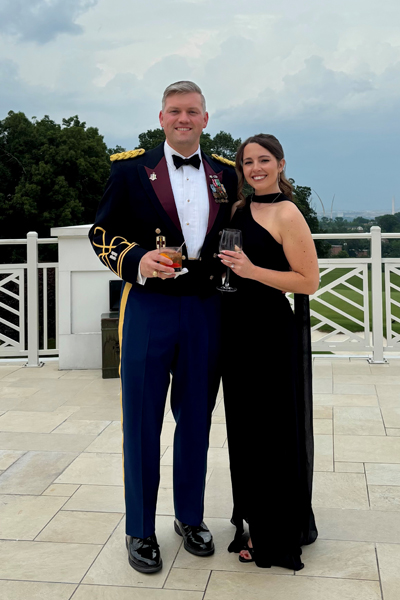
MAJ Greene and spouse, Jordyn, at the Jurist Doctorate Military Spouse Gala at the Army Navy Country Club, Arlington, Va.
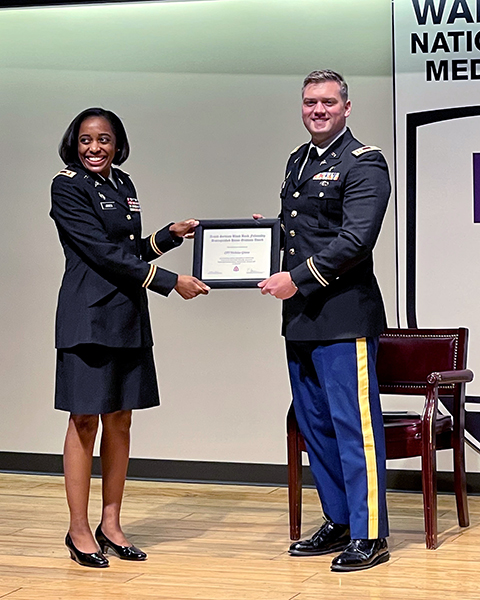
MAJ Greene being honored as Class of 2022 SBB Honor Graduate at Walter Reed National Military Medical Center Bethesda, Md.
Greene reflected on a proud moment from his deployment when he helped manage the blood supply following an operation that resulted in multiple casualties. Greene and his team manufactured blood through walking blood banks.
About a month later, Greene traveled elsewhere in theater to meet with doctors and discuss how he could best support them. He recalled one man standing up after his briefing to thank him for his team’s efforts, which helped save the lives of several of his soldiers and partner forces.
You don't always realize it in the moment, but the things you learn now — even if they don't seem directly tied to your end goal — will make you successful later.”
“Everything from my time at West Point, through lab school and blood banking school, to my time as a platoon leader working with soldiers — all of it prepared me to help him in that one moment, so he could do his job and care for his soldiers,” Greene said. “I don't think anything in my career will amount to that moment, because at the end of the day, I did what I needed to do to help him.”
Greene shared that his motivation stems from his family’s military history, which dates back to the Revolutionary War. “My grandfather was killed in Vietnam. I never met him, but if he hadn't been killed in Vietnam, my dad would never have met my mom, and I would never have been born. So, in a way, I feel like I owe it to him,” he said. “Between my grandparents and multiple family members who gave their lives overseas, that's the motivation. There's another generation coming, and I need to do everything I can to preserve our nation's values and protect our Constitution in whatever capacity I can for future generations.”
Greene advises early-career professionals to take advantage of every opportunity. “You don't always realize it in the moment, but the things you learn now — even if they don't seem directly tied to your end goal — will make you successful later,” he said. “When there's a problem nobody else has a solution for, you might be the one who does simply because you took the opportunity to learn something earlier.”
Greene expressed appreciation for the opportunity to understand AABB’s standards and accreditation processes and said he would recommend the AABB internship and similar experiences to junior officers.
“I showed up and felt like I was thrown right onto the team — in the best way, not just left to figure it out on my own,” Greene said. “It was welcoming, and no one ever treated me like busy work needed to be found for me. Everyone I worked with was genuinely invested in helping me learn and grow and understand AABB. When a junior officer is looking to do something similar, I'll definitely push them toward it. It was an awesome opportunity with a great team.”
PREVIOUS STORY
2026 AABB Annual Meeting Events: More to Explore in AtlantaBACK TO ISSUE
September 2026NEXT STORY
Giving Back: The Power of Mentorship
Transfusion is AABB’s scholarly, peer-reviewed monthly journal, publishing the latest on technological advances, clinical research and controversial issues related to transfusion medicine, blood banking, biotherapies and tissue transplantation. Access of Transfusion is free to all AABB members.
Learn More About Transfusion Journal
Keep abreast of what's happening in the field of biotherapies with CellSource - AABB's monthly update on the latest biotherapies news.

To submit news about the blood and biotherapies field to AABB, please email news@aabb.org.


President
Jose Cancelas, MD, PhD, CABP
Chief Executive Officer
Debra Ben Avram, FASAE, CAE
Chief Communications and Engagement Officer
Julia Zimmerman
Director of Marketing and Communications
Jay Lewis, MPH
Managing Editor
Kendra Y. Mims, MFA
Senior Communications Manager
Drew Case
AABB News
(ISSN 1523939X) is published monthly, except for the combined November/December issue for the members of AABB; 4550 Montgomery Avenue; Suite 700 North Tower; Bethesda, MD 20814.
AABB is an international, not-for-profit association representing individuals and institutions involved in transfusion medicine, cellular therapies and patient blood management. The association is committed to improving health by developing and delivering standards, accreditation and educational programs that focus on optimizing patient and donor care and safety.
+1.301.907.6977
Email: news@aabb.org
Website: www.aabb.org
Copyright 2025 by AABB.
Views and opinions expressed in AABB News are not necessarily endorsed by AABB unless expressly stated.
Notice to Copiers: Reproduction in whole or part is strictly prohibited unless written permission has been granted by the publisher. AABB members need not obtain prior permission if proper credit is given.


4550 Montgomery Avenue
Suite 700, North Tower
Bethesda, MD 20814
301.907.6977