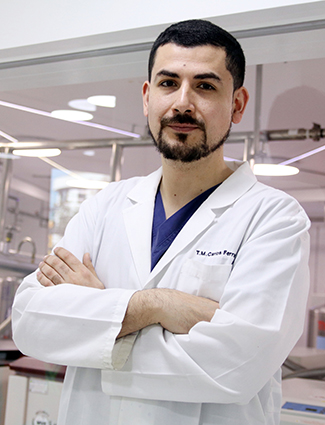
Carlos Ferrari Rebolledo, MSc, MT, is head of the laboratory at VidaCel in Chile, where he oversees operations for the country’s first umbilical cord blood and perinatal tissue bank accredited by AABB. He has extensive experience in transfusion medicine and cellular therapies across both public and private health sectors, with expertise in hematopoietic stem cell processing, cryopreservation and molecular diagnostics.
Ferrari began his career at the Clinical Hospital of the University of Chile and joined VidaCel in 2014 as laboratory coordinator before becoming laboratory head in 2018. He played a key role in the facility’s initial accreditation and ongoing reaccreditation. He also serves as co-director of AABB’s Spanish Language Subsection and as an adjunct professor at the Pontifical Catholic University of Valparaíso, where he teaches cellular therapies and regenerative medicine.
Ferrari spoke to AABB News about his career path, the challenges of achieving AABB accreditation and the evolving landscape of cellular therapies in Chile.
AABB NEWS: What first drew you to transfusion medicine and cellular therapies, and how did that interest shape your career path?
Ferrari: My interest began during my internship at the Blood Bank of the Chilean National Police (DIPRECA) Hospital, where I had the opportunity to witness a stem cell collection for a hematopoietic stem cell transplant (HSCT). That moment sparked a deep professional curiosity in me; realizing that cryopreservation was a relatively unexplored area at the undergraduate level, I dedicated entire nights to independently research methods and protocols. That curiosity quickly transformed into a professional goal and fate led me to my first job opportunity at the cell therapy laboratory of the University of Chile, which solidified my professional path.
AABB NEWS: You’ve worked across both public and private health systems in Chile. What differences have you observed in access to transfusion and cell therapy services?
Ferrari: My experience in both sectors has allowed me to observe a clear structural difference. In the public system, Chile has achieved efficiency through centralization: specialized blood centers concentrate processing and screening, supplying a network of transfusion medicine units (UMT). Meanwhile, the private system operates under a self-sustaining model, where each institution manages its own supply chain, from procurement to distribution.
Regarding cellular therapies, the gap is more pronounced. Currently, the private sector leads in processing infrastructure, forcing the public system to outsource these services. Although regulations for advanced therapies have recently been announced in Chile, which is a historic step forward, we are at the initial stages of implementation. This puts us at a competitive disadvantage compared with countries in the region that have decades of regulatory and operational maturity. Finally, the economic factor is the key determinant: the development and scaling up of these therapies is extremely expensive. Without clear financial incentives or public-private financing models, the high cost of the technology and supplies remain the main bottleneck for making these cutting-edge treatments accessible to the entire population.
AABB NEWS: As head of the laboratory at VidaCel, what are your top priorities in ensuring quality and safety?
Ferrari: My management is based on three critical pillars to guarantee the highest quality and safety:
End-to-end traceability: Together with my team, we have developed a robust system that ensures complete control of each unit from collection anywhere in Chile, through processing, to cryopreservation and storage.
Compliance with international standards: Given the lack of specific regulations for cord blood banks in Chile, we operate under the standards of AABB. This is our roadmap for maintaining operational excellence.
Commitment to patient safety: Our priority is to ensure that each sample is processed with the highest levels of biosafety, guaranteeing its future viability for the well-being of the families who place their trust in us.
AABB NEWS: You helped lead Chile’s first umbilical cord blood and perinatal tissue bank through the AABB accreditation process. What were the biggest challenges in reaching that milestone, and what impact has it had on patient care in Chile?
Ferrari: Achieving AABB accreditation was a transformative milestone that we tackled on two fronts. First, internally, the challenge was to evolve our institutional culture toward a mindset of continuous improvement and technical rigor. Second, externally, supply chain management was critical; we had to raise the bar for our local suppliers, who were not always accustomed to the compliance standards of an internationally accredited provider. The impact has been profound. Today, patients in Chile have access to a globally recognized service produced entirely local. Furthermore, thanks to our hybrid bank model, this benefit extends beyond our borders: we have successfully exported cord blood units for international transplants, validating that VidaCel quality is recognized and accepted by the most demanding centers in the world.
The current challenge is not only discovering new cures but also making them sustainable and scalable, so they reach patients in a timely manner, without economic factors limiting their lives.
AABB NEWS: What is a common misperception people have about your work or the blood and biotherapies field in general?
Ferrari: There's a perception that cell therapy prices are arbitrary, when they reflect the complexity of the processing. Ensuring the biological viability of a sample stored at -196°C requires constant investment in temperature monitoring systems, computerized process traceability systems and quality controls. My daily work involves balancing financial sustainability with compliance with international standards. In every center I know, the approach has been the same: to be as efficient as possible with resources to democratize access while understanding that cutting corners on critical processes without validation can jeopardize the safety of the final product and, consequently, the patient's life.
AABB NEWS: How are cell therapy and regenerative medicine evolving in Chile, and what challenges or opportunities do you see in expanding these services?
Ferrari: The evolution of cell therapy in Chile is at a historic turning point. The recent advanced therapies regulations are a necessary step that makes the arrival of pharmaceutical-based CAR –T-cell therapy in the country imminent. However, this presents a complex scenario for academic CAR –T-cell therapy: although there are national institutions with advanced developments, the new regulatory requirements, not initially foreseen, could slow its clinical implementation.
Considering this, I identify two critical challenges:
Regulatory harmonization: The challenge is not only to implement the regulations locally, but also to lead an integration effort in Latin America that allows for common standards.
Equitable access: Given the high cost of these biotherapies, the major ethical and economic dilemma is whether the public system will be able to integrate them or whether they will remain confined to the private sector.
Nevertheless, the opportunity is immense. With clear rules of the game, both public and private investment in developing local products is incentivized.
AABB NEWS: What role do international collaborations play in your work, and how have partnerships with organizations like AABB influenced your practice/laboratory?
Ferrari: International collaborations have been the cornerstone of our evolution. Our relationship with organizations like AABB compels us to continuous improvement, which positively impacts our commercial competitiveness and technical rigor.
The most valuable aspect of these collaborations is access to shared knowledge. On many occasions, when faced with new operational challenges, the support of international colleagues has been the key to success. Being able to consult with experts who have already navigated these situations saves us months of trial and error. It is this synergy, based on trust and professionalism, that allows us to offer a service in Chile that meets international standards.
AABB NEWS: Looking ahead, what do you see as the most important priorities for advancing transfusion medicine and cellular therapies throughout the world? What advances are you most excited about right now?
Ferrari: From my perspective, the absolute global priority is democratizing access. As science advances, the cost of personalized therapies has become a critical barrier. The current challenge is not only discovering new cures but also making them sustainable and scalable, so they reach patients in a timely manner, without economic factors limiting their lives.
What excites me most today is the dynamism of the CAR T-cell ecosystem. From my area of expertise in the laboratory, it's astonishing to observe how processing protocols have matured in such a short time. We are moving from 'cellular craftsmanship' to standardized, high-precision biotechnological production. Following these advances, both in the clinical setting and in production processes, confirms for me that we are experiencing the greatest revolution in the history of transfusion medicine.
AABB NEWS: What has been the most meaningful or rewarding moment in your career so far?
Ferrari: I have been very fortunate to experience the full cycle of my profession: from the rigorous process of hematopoietic stem cell processing to the critical moment of assisting hematologists during infusion and witnessing the patient's recovery. It is a satisfaction difficult to describe. However, if I had to choose a milestone, it would be taking on the role of a university professor. I am passionate about the opportunity to pass on this knowledge to new generations; it is a privilege to be able to tell my students that what I studied as the 'medicine of the future' is now, for us, the medicine of the present, and that they are the protagonists of this reality.
AABB NEWS: Outside of your work, what do you enjoy doing in your free time, or what’s a recent book, show or activity you’ve enjoyed?
Ferrari: Outside of the lab, my absolute priority is my family. Being a father has been the most rewarding experience of my life, so I cherish every moment with my wife and daughter. A fun fact is that we're huge Formula 1 fans: it's a ritual at home to watch every Grand Prix. They are my driving force and the foundation that allow me to successfully face the challenges of my professional career.
Transfusion is AABB’s scholarly, peer-reviewed monthly journal, publishing the latest on technological advances, clinical research and controversial issues related to transfusion medicine, blood banking, biotherapies and tissue transplantation. Access of Transfusion is free to all AABB members.
Learn More About Transfusion Journal
Keep abreast of what's happening in the field of biotherapies with CellSource - AABB's monthly update on the latest biotherapies news.

To submit news about the blood and biotherapies field to AABB, please email news@aabb.org.


President
Jose Cancelas, MD, PhD, CABP
Chief Executive Officer
Debra Ben Avram, FASAE, CAE
Chief Communications and Engagement Officer
Julia Zimmerman
Director of Marketing and Communications
Jay Lewis, MPH
Managing Editor
Kendra Y. Mims, MFA
Senior Communications Manager
Drew Case
AABB News
(ISSN 1523939X) is published monthly, except for the combined November/December issue for the members of AABB; 4550 Montgomery Avenue; Suite 700 North Tower; Bethesda, MD 20814.
AABB is an international, not-for-profit association representing individuals and institutions involved in transfusion medicine, cellular therapies and patient blood management. The association is committed to improving health by developing and delivering standards, accreditation and educational programs that focus on optimizing patient and donor care and safety.
+1.301.907.6977
Email: news@aabb.org
Website: www.aabb.org
Copyright 2025 by AABB.
Views and opinions expressed in AABB News are not necessarily endorsed by AABB unless expressly stated.
Notice to Copiers: Reproduction in whole or part is strictly prohibited unless written permission has been granted by the publisher. AABB members need not obtain prior permission if proper credit is given.

4550 Montgomery Avenue
Suite 700, North Tower
Bethesda, MD 20814
301.907.6977