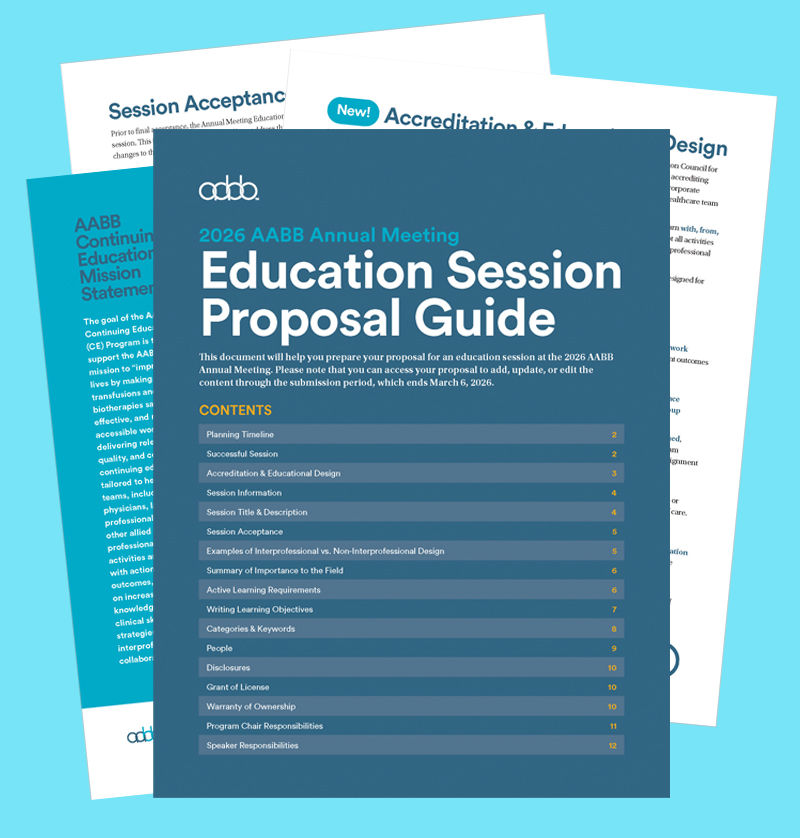
The 2026 AABB Annual Meeting—taking place Oct. 17-19 in Atlanta—will showcase the latest research and practice-changing resources in the fields of blood and biotherapies. AABB invites members to help shape the future of transfusion medicine, blood banking and biotherapies by submitting an education session proposal for the meeting.
For more than 75 years, the AABB Annual Meeting has set the standard for high-quality, timely education in the field. By contributing an education session proposal or topic idea, members of the blood and biotherapies community play a vital role in continuing this legacy, showcasing their expertise, advancing the profession and ensuring that the AABB Annual Meeting remains the preeminent event for the field.
The deadline for submissions is Friday, March 6. Proposals can be updated and edited throughout the submission period. Proposals may be updated and edited throughout the submission period, and AABB offers a comprehensive educational session proposal guide to assist in preparing a submission.
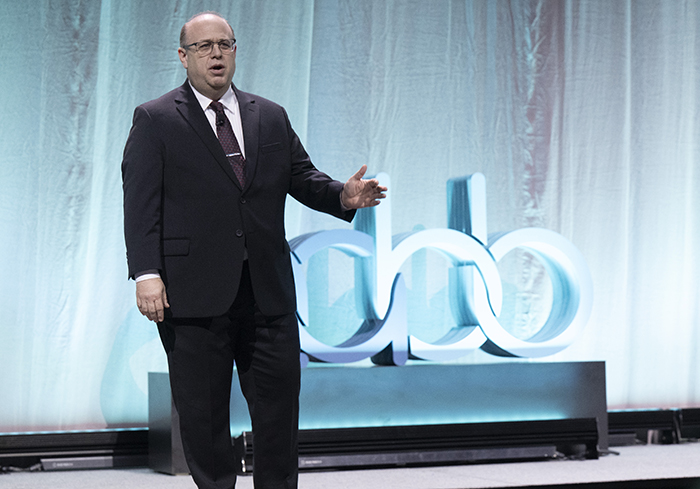
Steven Armstrong, DHA, MLS(AMT), SBB(ASCP), FACHE, chair of the Annual Meeting Education Committee (AMEC), spoke with AABB News about the key elements of a strong education session proposal, the mentoring initiative for new presenters and the selection process.
Although the approach may not be much different, the opportunity to increase the number of proposals submitted for review should only enhance our session offerings at the AABB Annual Meeting. The Annual Meeting's educational sessions are selected from the pool of submitted proposals. Therefore, if we can increase the number of proposals, the AMEC can continue to select sessions that remain of the highest quality and inclusive for our varied attendees.
The AABB Annual Meeting themes and priorities are guided by our membership – not necessarily just those of the AMEC. While the AMEC is aware of various “hot topics” within each discipline, and we do use attendee feedback to identify “knowledge gaps,” it is ultimately through the session proposal process that shapes our AABB Annual Meeting. The AMEC has experts across the various disciplines that make up AABB, and by having active experts serve on the AMEC, our sessions reflect the most up-to-date research, practices and information available.
The AMEC, based on attendee feedback and other methods for identifying knowledge gaps, is aware of areas for which AABB Annual Meeting attendees would like more content. Recently, attendees have requested more sessions on emerging technologies such as artificial intelligence and cybersecurity. And consistently there is always a high demand for education in the areas of leadership, quality, immunohematology and biotherapies. Of course, we have to ensure we balance our sessions to appeal to all the Annual Meeting’s attendees. With that said, we welcome proposals on any topic members feel is underrepresented.
In a single word: clarity. The sessions that clearly state their topic, objectives and how the topic will be presented are far more likely to be selected. Strong proposals also provide enough detail for reviewers to clearly understand what is novel or particularly important about the session and how it will advance practice in the field. This level of specificity helps the committee fully appreciate the educational value, relevance and take-home impact for learners.
When AMEC members must start interpreting the topic, the objectives or how the information will be shared, it becomes extremely difficult to advance the session. Taking the time to write a clear, well-developed proposal ensures that selection teams do not have to guess the intent or importance of the presentation. To support submitters in this process, we have added additional submission guidance this year to help ensure proposals include the information needed to be successful.
The AMEC is lucky to have experts in numerous fields on our various selection teams. These experts help ensure the submission objectives and presentation style are conducive to creating meaningful and even actionable takeaways for the submitted topic. A great topic, if presented poorly, will not leave a lasting impression. Therefore, one long-term goal is not only to focus on improving submissions but also to work with presenters to enhance everyone’s experience. Through both processes, AMEC is working to ensure the information presented during the AABB Annual Meeting yields more takeaways for attendees and helps them begin to formulate how to implement the ideas within their organizations.
The AMEC functions as a true peer-review body. Committee members are organized into selection teams based on their subject-matter expertise across the full range of AABB Annual Meeting topic areas. Each proposal is reviewed and scored independently by multiple experts who are deeply familiar with the content area, ensuring that submissions are evaluated for educational rigor, relevance and potential impact on practice.
Following this independent review, proposals are discussed collectively within each expert team. This deliberative process allows the committee to identify sessions that translate new or emerging topics into meaningful, practical takeaways, while also shaping a balanced and comprehensive program that meets the needs of the diverse AABB community. A strong topic alone is not enough; successful proposals must clearly articulate an effective educational approach that supports learning and application.
The process is highly competitive, with approximately half of submitted proposals ultimately accepted. In parallel with selection, AMEC is also committed to working with presenters to strengthen session delivery and engagement, recognizing that even the most innovative content is most effective when it is presented clearly and thoughtfully. Together, this rigorous peer-review process and ongoing faculty development help ensure that the AABB Annual Meeting delivers high-quality, actionable education for attendees.
When the AMEC encounters a topic of great interest, but the submission itself is lacking, the committee can seek the clarity needed to make a decision. In addition to providing suggestions for improving the title, description, objectives, formatting and grammar, the committee might also ask that additional areas of interest or counterpoints be included to ensure the program is well-rounded.
We are very excited about a new mentorship initiative that is being piloted this year. It is designed to support early-career professionals and first-time presenters. This program pairs newer speakers with experienced faculty who have a track record of successful proposals and effective presentation. We understand that the AABB Annual Meeting will only continue to improve if the next generation of speakers are given opportunities, encouraged and mentored. The mentoring programs we have implemented are meant to provide a pathway for a diverse range of presenters to find a stage so their voices can be heard.
If established speakers are interested in serving as mentors, or early-career or first-time presenters would like to be paired with a mentor, they should contact professionaldevelopment@aabb.org.
What excites me most is the opportunity to see the breadth of ideas and perspectives that the community brings forward each year. For the 2026 AABB Annual Meeting, the AMEC has taken deliberate steps to encourage a wide range of proposals—across topic areas, professional roles, practice settings and geographic regions—so that the final program reflects both emerging issues and the evolving needs of our field.
AABB’s work spans many disciplines and has a truly global footprint, and the proposal process is designed to invite contributions that reflect that diversity. Although we don’t yet know what the final program will look like, it is always energizing to see how members interpret current challenges and innovations and translate them into educational opportunities. That diversity of thought and experience is what ultimately makes the AABB Annual Meeting dynamic and valuable for attendees.
When submitting a proposal, you are not alone. Meaning, the submission website takes you through the process, gives examples of what is expected, and if selected, you will work with an AMEC member to ensure your presentation meets all the criteria. AMEC team members will work with you to ensure you don’t feel alone throughout the process. Although I understand it can seem daunting, submitting a proposal is the first step in making a difference. AABB and the AMEC are willing partners in your growth.
In addition to the items already mentioned, one way to enhance a proposal, when possible, is to ensure that multiple points of view are presented. That can be as simple as having speakers from different organizations present on a topic. Although it is understandable that some topics will be from a single organization or facility, most can often have speakers from different organizations. This diversity demonstrates that the submission is of broad interest and can provide a different perspective.
The call for education session proposals for the 2026 AABB Annual Meeting is now open. Session proposals are due on or before Friday, March 6, 2026, at 3 p.m. ET. Please note that you can access your proposal to add, update or edit the content throughout the submission period.
BACK TO ISSUE
February 2026
Transfusion is AABB’s scholarly, peer-reviewed monthly journal, publishing the latest on technological advances, clinical research and controversial issues related to transfusion medicine, blood banking, biotherapies and tissue transplantation. Access of Transfusion is free to all AABB members.
Learn More About Transfusion Journal
Keep abreast of what's happening in the field of biotherapies with CellSource - AABB's monthly update on the latest biotherapies news.

To submit news about the blood and biotherapies field to AABB, please email news@aabb.org.


President
Jose Cancelas, MD, PhD, CABP
Chief Executive Officer
Debra Ben Avram, FASAE, CAE
Chief Communications and Engagement Officer
Julia Zimmerman
Director of Marketing and Communications
Jay Lewis, MPH
Managing Editor
Kendra Y. Mims, MFA
Senior Communications Manager
Drew Case
AABB News
(ISSN 1523939X) is published monthly, except for the combined November/December issue for the members of AABB; 4550 Montgomery Avenue; Suite 700 North Tower; Bethesda, MD 20814.
AABB is an international, not-for-profit association representing individuals and institutions involved in transfusion medicine, cellular therapies and patient blood management. The association is committed to improving health by developing and delivering standards, accreditation and educational programs that focus on optimizing patient and donor care and safety.
+1.301.907.6977
Email: news@aabb.org
Website: www.aabb.org
Copyright 2025 by AABB.
Views and opinions expressed in AABB News are not necessarily endorsed by AABB unless expressly stated.
Notice to Copiers: Reproduction in whole or part is strictly prohibited unless written permission has been granted by the publisher. AABB members need not obtain prior permission if proper credit is given.

4550 Montgomery Avenue
Suite 700, North Tower
Bethesda, MD 20814
301.907.6977