I am confident that AABB Foundation’s support of young, enthusiastic and innovative investigators to develop their novel ideas will also lead to similarly important discoveries and therapeutic approaches in the future.
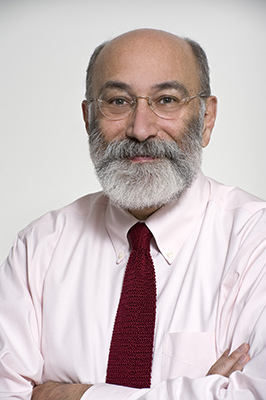
Behind every breakthrough in transfusion medicine and biotherapies, there is a community of dedicated supporters turning research and innovation into real-life impact for patients, donors and their families. Among them is Steven Spitalnik, MD, whose contributions to the Association have made a meaningful difference through the AABB Foundation, especially at a time when philanthropy is more vital than ever to advancing the field.
In sharing his story, Spitalnik reflects on what drew him to blood and biotherapies, the experiences that have shaped his path and why supporting the Foundation is so important to him. His hope is that you will be inspired to join him in transforming science into life-changing outcomes for millions of people throughout the world.
During residency training in anatomic and clinical pathology, my first rotation in transfusion medicine was early in 1980. I knew nothing about transfusion medicine before that time, and I fell in love with the field virtually immediately. I particularly enjoyed combining some direct patient care (not usually available to pathologists) with clinical laboratory testing. The fact that serological testing for antibodies to blood group antigens was somewhat esoteric and involved “special knowledge” was also appealing to me.
I attended my first AABB meeting in 1980 to get a better idea about the nature of the field, in general, and to gain some insights into the culture and nature of the individuals involved. Again, I felt immediately comfortable with the members of the transfusion medicine “family,” which convinced me to pursue subspecialty training and join the field.
This grant from the AABB Foundation was incredibly important for my career. After 20 years of pursuing basic research in glycobiology, which had little, if anything, to do with transfusion medicine, I had made the risky decision to change my research focus completely to pursue translational studies directly related to transfusion medicine. In particular, I decided to develop mouse models to study the pathophysiology of hemolytic transfusion reactions, with the goal that unraveling the underlying mechanisms would lead to improvements in prevention and treatment. This was partially motivated by having cared for several patients over the years who experienced an acute hemolytic transfusion reaction, for which our therapeutic armamentarium included fluids, diuretics, hope and prayer—none of which had been validated by clinical trials.
Unfortunately, it was very difficult for me to obtain extramural funding to pursue these studies, with the underlying critique of our approach being that “only about 10 Americans die each year from a hemolytic transfusion reaction,” so this was not viewed as a priority. Given these funding difficulties, my research laboratory was on the verge of closing permanently, and it was literally saved by this funding.
Indeed, at that time, the AABB Foundation grant program was not only open to young, new investigators, but also available to more senior investigators who were changing fields. Although I was certainly a senior transfusion medicine physician, my prior research did not focus on transfusion medicine issues, so I was eligible to apply for an AABB Foundation grant.
There are many opportunities to provide safer and more effective care for our patients. To date, all of these types of advances were built upon a foundation of fundamental research aimed at understanding the mechanisms of disease, the functions of blood components, and the ways in which blood components can be manipulated to provide more targeted therapy. Prominent recent examples include: identifying hepatitis C virus as the cause of “non-A, non-B hepatitis” and developing a diagnostic test to enhance the safety of the blood supply; developing a safe, effective, recombinant form of Factor VIII to treat hemophilia; and developing the molecular biology methods required to produce CAR-T cells. I am confident that AABB Foundation’s support of young, enthusiastic and innovative investigators to develop their novel ideas will also lead to similarly important discoveries and therapeutic approaches in the future.
First of all, I am extremely grateful for receiving Foundation support during a particularly difficult time in my career and feel that the donations from my wife, Dr. Patrice Spitalnik, and me are a way of paying back and paying forward. Secondly, I continue to be impressed by the quality of the enthusiastic individuals entering our field, and by their innovative ideas and approaches to enhancing our understanding of the scientific basis for transfusion medicine and for improving patient care.
In many ways, I think of the AABB membership as my “professional family,” and I have “grown up” within its nurturing environment and atmosphere. I have had many friends, colleagues and co-mentors throughout the years, and attending the AABB Annual Meetings has always been an uplifting and meaningful experience for me.
I hope that the AABB Foundation will continue to encourage and support individuals interested in pursuing research in transfusion medicine. When I look back on my 50-year career, the advances made (by others!) in the science and practice of transfusion medicine have been remarkable and astounding. I anticipate that the next 50 years will be similarly amazing and that the activities of the AABB Foundation will be centrally important in the new discoveries to come. I believe that the future is very bright.
Traditionally, it has been very difficult for individuals in transfusion medicine to obtain extramural research funding. There are many reasons for this, which would take me too long to describe. Given that the AABB Foundation provides funds for individuals to (typically) obtain preliminary data for novel ideas that could then lead to larger grants from other entities (e.g., the National Institutes of Health), if the AABB Foundation did not exist, then it would make it that much more difficult, or impossible, for young investigators in our field to begin their research careers.
The future is very bright, and you should just jump in somewhere and get started. The range of sophisticated, novel methods available to exploit is immense; important questions exist that need insight and answers, and the breadth of the field of transfusion medicine continues to grow. Finally, I believe that mentorship is very important and extremely helpful in navigating a career that involves research; we all need engaged and supportive mentors at each stage of our lives, so be active in finding the right ones. None of us does this alone.
I remember when the AABB Foundation began; at the time, it was called the National Blood Foundation. Those grants, albeit small, were a tremendous help to jump-start the research careers of multiple individuals, many of whom made important contributions and became leaders in our field. All contributions to the Foundation are valuable and every little bit helps. In particular, I think it is very important to grow the endowment to allow more projects to be funded each year and, hopefully, to provide more funding for each project.
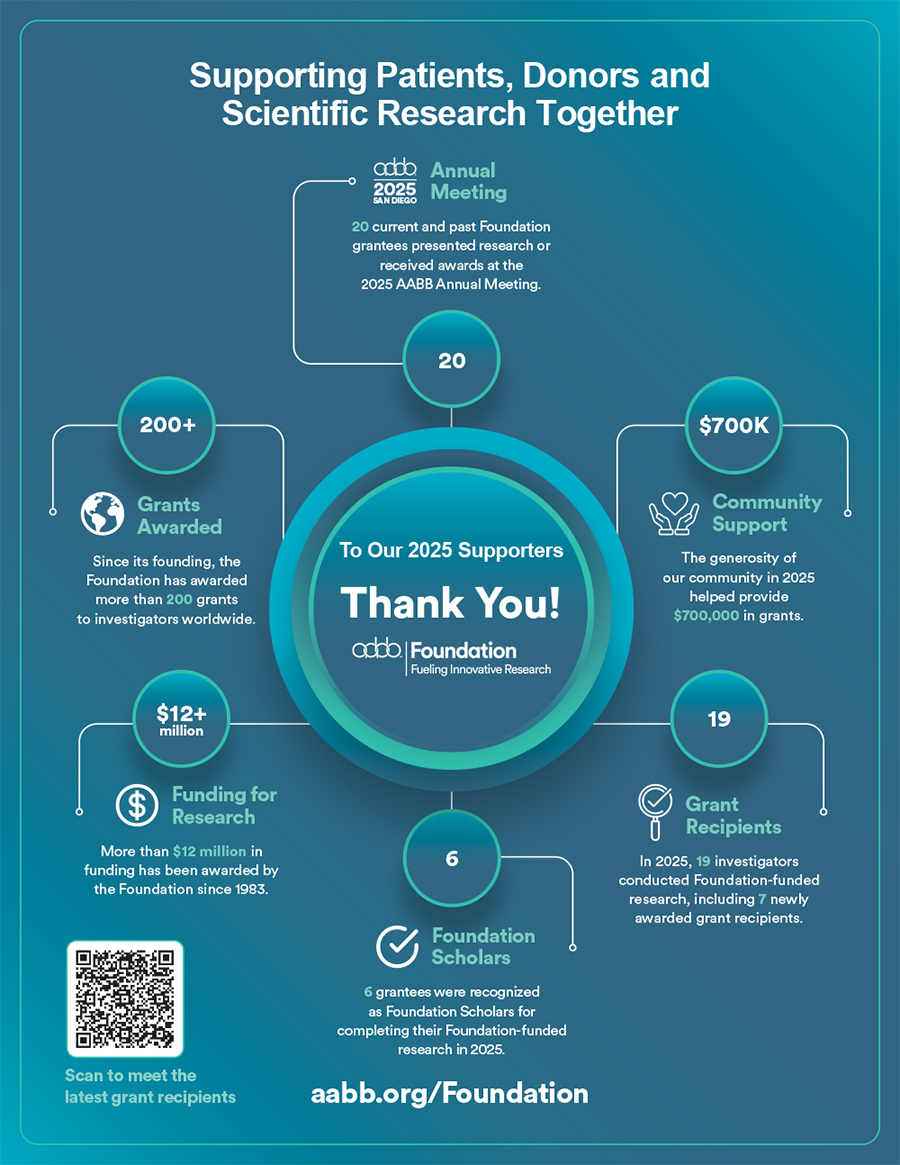
Throughout the years, the generous gifts from supporters like Steven and Patrice Spitalnik have funded more than 200 research grants and awards, leading to major scientific discoveries in our field.
With your help right now, the next medical breakthrough will be within our reach. Your donation today to the AABB Foundation can empower the next innovator in blood and biotherapies research—a visionary whose work may one day revolutionize treatments for patients worldwide. Contribute today and be a vital part of fueling innovative research.
BACK TO ISSUE
January 2026NEXT STORY
Building an Equitable Blood Supply
Transfusion is AABB’s scholarly, peer-reviewed monthly journal, publishing the latest on technological advances, clinical research and controversial issues related to transfusion medicine, blood banking, biotherapies and tissue transplantation. Access of Transfusion is free to all AABB members.
Learn More About Transfusion Journal
Keep abreast of what's happening in the field of biotherapies with CellSource - AABB's monthly update on the latest biotherapies news.

To submit news about the blood and biotherapies field to AABB, please email news@aabb.org.


President
Jose Cancelas, MD, PhD, CABP
Chief Executive Officer
Debra Ben Avram, FASAE, CAE
Chief Communications and Engagement Officer
Julia Zimmerman
Director of Marketing and Communications
Jay Lewis, MPH
Managing Editor
Kendra Y. Mims, MFA
Senior Communications Manager
Drew Case
AABB News
(ISSN 1523939X) is published monthly, except for the combined November/December issue for the members of AABB; 4550 Montgomery Avenue; Suite 700 North Tower; Bethesda, MD 20814.
AABB is an international, not-for-profit association representing individuals and institutions involved in transfusion medicine, cellular therapies and patient blood management. The association is committed to improving health by developing and delivering standards, accreditation and educational programs that focus on optimizing patient and donor care and safety.
+1.301.907.6977
Email: news@aabb.org
Website: www.aabb.org
Copyright 2025 by AABB.
Views and opinions expressed in AABB News are not necessarily endorsed by AABB unless expressly stated.
Notice to Copiers: Reproduction in whole or part is strictly prohibited unless written permission has been granted by the publisher. AABB members need not obtain prior permission if proper credit is given.

4550 Montgomery Avenue
Suite 700, North Tower
Bethesda, MD 20814
301.907.6977